
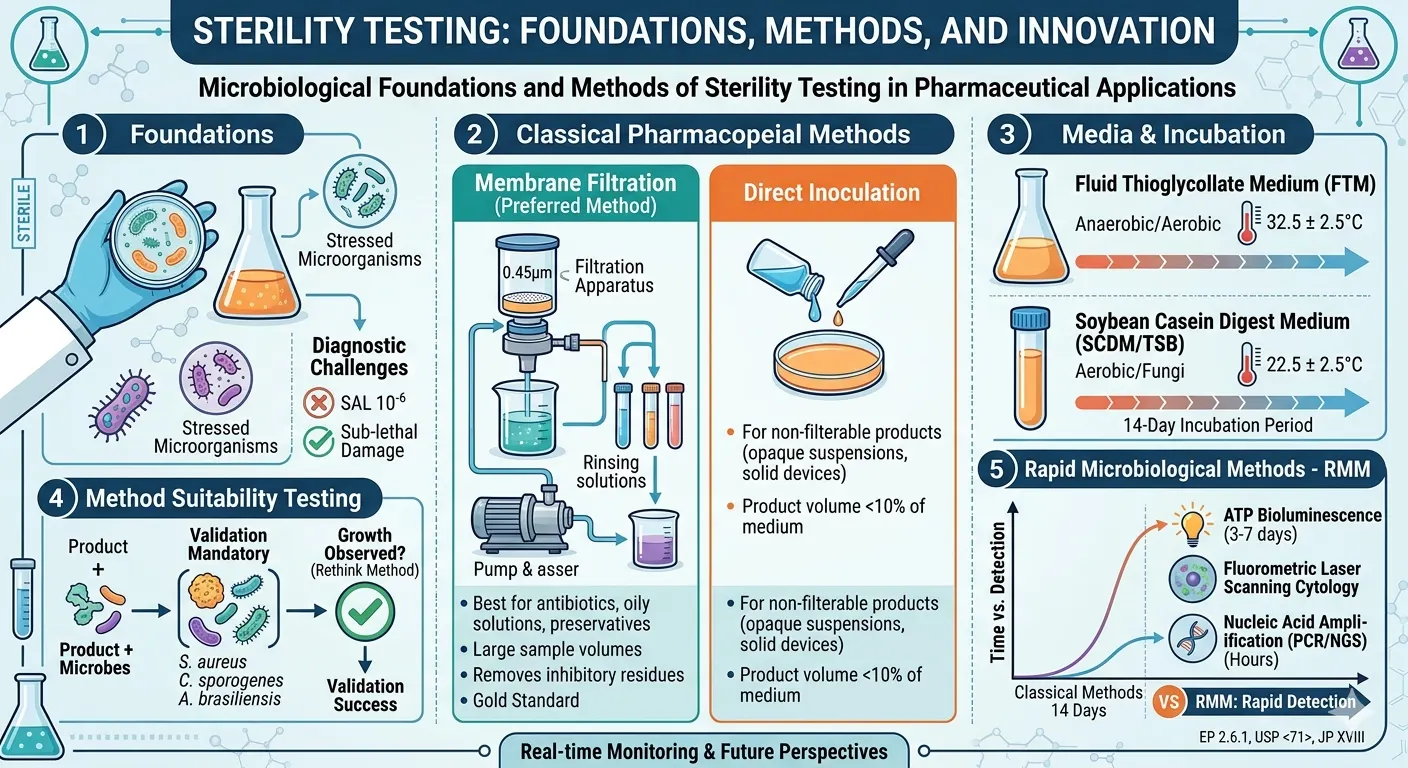
The safe use of sterile products is considered one of the fundamental requirements of modern pharmaceutical and biotechnological applications. Particularly for injectable preparations, ophthalmic products, and invasive medical devices, sterility is not merely a quality parameter but a critical necessity directly impacting patient health. In this context, sterility tests are among the most essential microbiological analyses aimed at evaluating whether the microbial risks encountered throughout the production process have been effectively controlled.
Conventional sterility tests applied in microbiology are primarily methods based on incubation in liquid media, aiming to reveal the presence of viable microorganisms. Direct inoculation and membrane filtration approaches have been in use for many years and have been standardized by international authorities such as the European Pharmacopoeia (EP), the United States Pharmacopeia (USP), and the Japanese Pharmacopoeia (JP) (European Pharmacopoeia, 2023; USP <71>; JP XVIII). However, the requirement for long incubation periods and the limitations in detecting low-level contamination have led to an increasing interest in Rapid Microbiological Methods (RMM) in recent years.
This review examines the microbiological foundations of sterility tests, provides a comparative analysis of the classical test methods defined in pharmacopoeias, and evaluates the strengths and weaknesses of these methods in practical applications in light of literature data.
1. Microbiological Foundations and Diagnostic Challenges of Sterility Testing
Sterility testing is a statistical probability method that determines whether viable microorganisms are present at a detectable level in the tested sample, rather than providing an absolute proof of "sterility." Although sterility is theoretically defined as the "complete absence of viable microorganisms" (Sterility Assurance Level - SAL of 10^-6), the analytical process is subject to limitations such as sampling errors and the biological state of the microorganisms.Contaminants encountered in pharmaceutical products are often "stressed" microorganisms. It is critical to provide appropriate environmental conditions for cells that have been damaged but not entirely killed (sub-lethal damage) by sterilization cycles (heat, radiation, filtration) to reactivate within the culture media.
2. Classical Methods in Pharmacopeial Standards: A Comparative Analysis
Pharmacopoeias (USP <71>, EP 2.6.1) focus on two main protocols for sterility testing: Membrane Filtration and Direct Inoculation.2.1. Membrane Filtration Method (The Gold Standard)
Membrane filtration is the preferred method, especially for antibiotics, oily solutions, and products containing preservatives. In this method, the product is passed through a filter with a nominal pore size of 0.45 µm. While microorganisms are retained on the membrane, the inhibitory (bactericidal/bacteriostatic) effect of the product is removed using rinsing solutions. Advantages: Allows for the analysis of large sample volumes and the elimination of antimicrobial residues. Disadvantages: Increased risk of secondary contamination during the assembly of the filtration apparatus.2.2. Direct Inoculation Method
This method is used for products that cannot be filtered, such as opaque suspensions or solid medical device components. The test sample is added directly to the culture media. The most critical parameter here is that the volume of the product must not exceed 10% of the medium volume; otherwise, the nutritional properties of the medium may be diluted.3. Media Selection and Incubation Parameters
Two main culture media with broad-spectrum growth capacities are used in classical tests: Fluid Thioglycollate Medium (FTM): Designed primarily for the detection of anaerobic bacteria due to its low redox potential, though it also supports the growth of aerobic bacteria. The incubation temperature is generally 32.5 \pm 2.5°C. Soybean Casein Digest Medium (SCDM / TSB): Optimized for fungi (yeast and molds) and aerobic bacteria. The incubation temperature is maintained at 22.5 \pm 2.5°C. Both media are standardly incubated for 14 days. This duration is necessary for slow-growing strains and damaged cells to complete their repair processes.4. Validation and Method Suitability Testing
A "negative result" in sterility tests may not necessarily mean the product is sterile; the product itself might be inhibiting microbial growth. Therefore, Method Suitability Tests are mandatory under pharmacopeial rules. In this process, indicator strains such as Staphylococcus aureus, Bacillus subtilis, Pseudomonas aeruginosa, Clostridium sporogenes, Candida albicans, and Aspergillus brasiliensis are inoculated into the test system at low CFU counts (<100). If growth is not observed in the presence of the product, the method must be revised (e.g., using more rinses or neutralizing agents) and re-validated.5. Limitations of Classical Methods and Rapid Microbiological Methods (RMM)
The primary disadvantage of classical methods is the "time" factor. A 14-day waiting period is not feasible for short-shelf-life radiopharmaceuticals and Advanced Therapy Medicinal Products (ATMPs). Furthermore, classical methods can only detect "culturable" microorganisms.RMMs developed to overcome these bottlenecks include: ATP Bioluminescence: Provides results in 3–7 days by detecting cellular ATP. Fluorometric Laser Scanning Cytology: Detection of viable cells by marking them with fluorescent dyes.
Nucleic Acid Amplification Technologies (PCR/NGS): Detection of the genetic material of the microorganism (results within hours).
6. Conclusion and Future Perspectives
Sterility testing is the most critical line of defense in pharmaceutical microbiology. However, modern biotechnology necessitates moving beyond the traditional 14-day testing period. In the future, with the widespread adoption of pharmacopeia-approved RMM systems and the integration of AI-supported image analysis systems into laboratories, "real-time" sterility monitoring will become possible. Academic researchers focusing on the detection risks of Viable But Non-Culturable (VBNC) microorganisms will elevate patient safety to a higher level.REFERENCES
1. European Pharmacopoeia Commission. (2023). European Pharmacopoeia (11th ed., Chapter 2.6.1: Sterility). European Directorate for the Quality of Medicines & HealthCare (EDQM), Strasbourg.2. United States Pharmacopeial Convention. (2023). USP–NF, General Chapter <71>: Sterility Tests. Rockville, MD.
3. Ministry of Health, Labour and Welfare. (2021). The Japanese Pharmacopoeia (18th ed., General Tests: Sterility). Tokyo, Japan.
4. Sutton, S. (2010). The sterility test. Journal of Validation Technology, 16(2), 1–10.
5. Sutton, S. (2011). The sterility test in pharmaceutical microbiology. Journal of GXP Compliance, 15(4), 85–94.
6. Moldenhauer, J. (2011). Rapid microbiological methods in the pharmaceutical industry. PDA Journal of Pharmaceutical Science and Technology, 65(3), 245–256.
7. Sandle, T. (2016). Pharmaceutical Microbiology: Essentials for Quality Assurance and Quality Control. Woodhead Publishing.
No comments yet. You can leave the first one.