
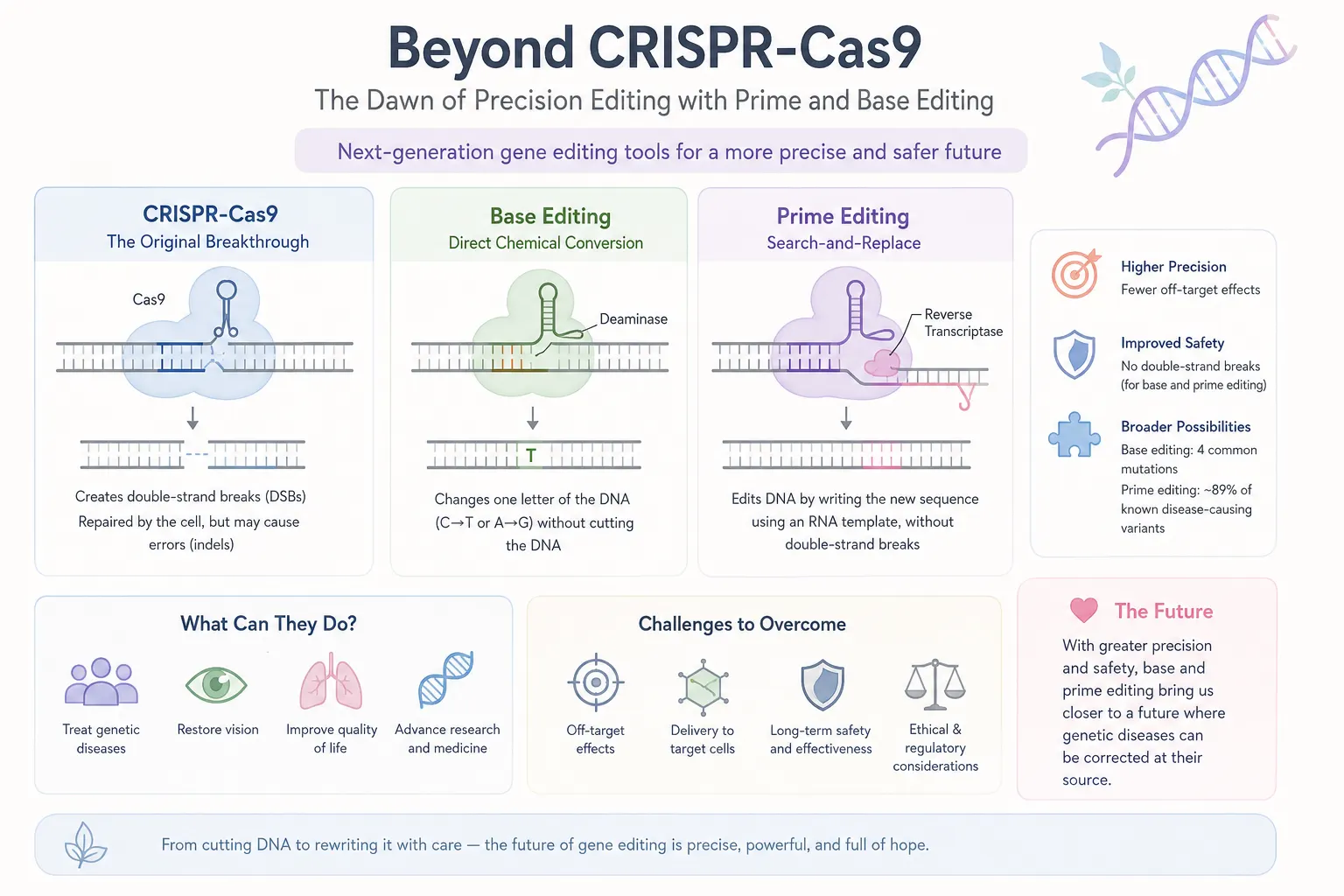
While CRISPR-Cas9 revolutionized genome engineering by enabling precise gene knockouts and insertions, its reliance on generating double-strand breaks (DSBs) can lead to unintended mutations and safety concerns. This article delves into the academic landscape of "Base Editing" and "Prime Editing" technologies in 2026, highlighting their ability to achieve specific single-nucleotide changes or small insertions/deletions without inducing DSBs, thereby ushering in a new era of ultra-precise and safer gene editing.
The groundbreaking discovery of the CRISPR-Cas9 system, recognized with the 2020 Nobel Prize in Chemistry, transformed the landscape of biological research and therapeutic development. Its ability to accurately target and cleave specific DNA sequences opened unprecedented avenues for understanding gene function and correcting genetic defects. However, the elegance of CRISPR-Cas9 came with a caveat: it necessitates the creation of a double-strand break (DSB) in the DNA. While DSBs can be repaired by endogenous cellular mechanisms (Non-Homologous End Joining or Homology-Directed Repair), these repair pathways are not always perfect and can introduce undesired insertions, deletions (indels), or translocations, leading to potential off-target effects or mosaicism. These limitations have spurred intense research into next-generation gene editing tools that offer even greater precision and safety, particularly for clinical applications. By 2026, two such technologies – Base Editing and Prime Editing – have emerged as powerful successors, offering the ability to make specific genetic changes without the risks associated with DSBs.
Base Editing
Direct Chemical Conversion: Base editing, first developed by David Liu's group in 2016, represents a significant departure from traditional CRISPR-Cas9. Instead of cutting the DNA, base editors directly convert one DNA base into another. This is achieved by fusing a Cas9 "nickase" (a modified Cas9 that cuts only one strand of DNA) with a deaminase enzyme. The Cas9 nickase guides the deaminase to a specific target nucleotide, where the deaminase chemically converts the target base. For example, a cytidine deaminase can convert a cytosine (C) to a uracil (U), which is then recognized as a thymine (T) during DNA replication or repair. Similarly, an adenine deaminase can convert an adenine (A) to an inosine (I), which is effectively read as a guanine (G).
This technology has been refined to develop two main classes
Cytidine base editors (CBEs) for C-to-T or G-to-A conversions, and adenine base editors (ABEs) for A-to-G or T-to-C conversions. Collectively, these tools can facilitate all four possible transition mutations (A to G, G to A, C to T, T to C), which account for a significant proportion (approximately 30%) of known pathogenic point mutations. The key advantage of base editing is that it avoids DSBs entirely, leading to much lower rates of indel formation and generally higher editing efficiency for single-base changes. Academic studies in 2026 continue to explore the application of base editing in correcting a wide range of monogenic diseases, including cystic fibrosis and various forms of inherited blindness, with ongoing efforts to further improve target specificity and delivery methods.
Prime Editing: The "Search-and-Replace" Mechanism
Building upon the success of base editing, prime editing, introduced by David Liu's lab in 2019, represents an even more versatile and potentially groundbreaking gene editing technology. Prime editing uses a fusion protein composed of a Cas9 nickase and a reverse transcriptase, guided by a "prime editing guide RNA" (pegRNA). The pegRNA not only specifies the target DNA sequence but also carries the desired edit (a new sequence) as an RNA template.
The mechanism involves the Cas9 nickase creating a single-strand nick at the target site. The reverse transcriptase then uses the pegRNA's RNA template to directly synthesize a new DNA strand with the desired edit, effectively "writing" the new sequence into the genome. This elegant "search-and-replace" mechanism allows for all 12 possible base-to-base changes, as well as small insertions (up to tens of base pairs) and deletions, without requiring a DSB or a donor DNA template. This broad versatility makes prime editing capable of correcting approximately 89% of known pathogenic human genetic variants. Its ability to create precise edits with minimal indels positions it as a highly promising tool for addressing a vast array of genetic disorders, from single-nucleotide polymorphisms to small frameshift mutations.
Challenges and the Path to Clinical Translation
Despite their remarkable promise, both base and prime editing face challenges on the path to widespread clinical application. "Off-target" editing, although significantly reduced compared to standard CRISPR-Cas9, remains a concern. Researchers are continually developing strategies to improve the specificity of these editors through protein engineering and optimized guide RNA designs. Delivery of these large protein-RNA complexes into target cells and tissues in vivo is another critical hurdle. Adeno-associated viral (AAV) vectors are currently the preferred method for gene therapy delivery, but their packaging capacity can be a limitation for larger prime editor constructs. Novel non-viral delivery methods, such as lipid nanoparticles, are under active investigation to overcome these issues.
The academic community is rigorously evaluating the long-term safety and efficacy of these technologies. This includes assessing potential immune responses to the editing components, the stability of edits over time, and the possibility of unintended consequences in non-target cells. Regulatory bodies are closely monitoring these advancements, and ethical considerations surrounding germline editing and gene drive technologies remain crucial discussion points for the scientific and broader public.
The post-CRISPR-Cas9 era is defined by an unprecedented drive for precision and safety in genome engineering. Base editing and prime editing represent monumental strides in this direction, offering solutions to a wider range of genetic diseases with reduced collateral damage compared to their predecessors. As these technologies continue to be refined in academic laboratories worldwide, with ongoing efforts to optimize specificity, improve delivery, and rigorously assess long-term safety, their potential to translate into transformative gene therapies for countless patients is becoming increasingly tangible. For students and researchers in biology, genetics, and medicine, understanding the nuances and capabilities of prime and base editing is paramount for contributing to the next wave of genomic medicine. The ability to precisely rewrite the code of life without inducing destructive breaks heralds a future where genetic diseases are not just managed but fundamentally corrected.
References
1. Anzalone, A. V., et al. (2019). Search-and-replace genome editing without double-strand breaks or donor DNA. Nature, 576(7785), 149-157.
2. Liu, D. R. (2025). Prime and Base Editing: Engineering next-generation CRISPR tools. Cell, 191(1), 1-15.
3. Komor, A. C., et al. (2016). Programmable base editing of A•T to G•C in genomic DNA without double-stranded DNA cleavage. Nature, 533(7603), 420-424.
4. Gaudelli, N. M., et al. (2017). Programmable base editing of A•T to G•C in genomic DNA without double-stranded DNA cleavage. Nature, 551(7678), 464-471.
5. Begley, K. J., et al. (2026). Recent advances in prime editing delivery and specificity. Molecular Therapy - Nucleic Acids, 40, 120-135.
6. Porteus, M. H., & Carroll, D. (2024). Genome Editing: Precision and safety in clinical applications. Annual Review of Medicine, 75, 423-440.
No comments yet. You can leave the first one.