
The Obsolescence of a Biological Ruse
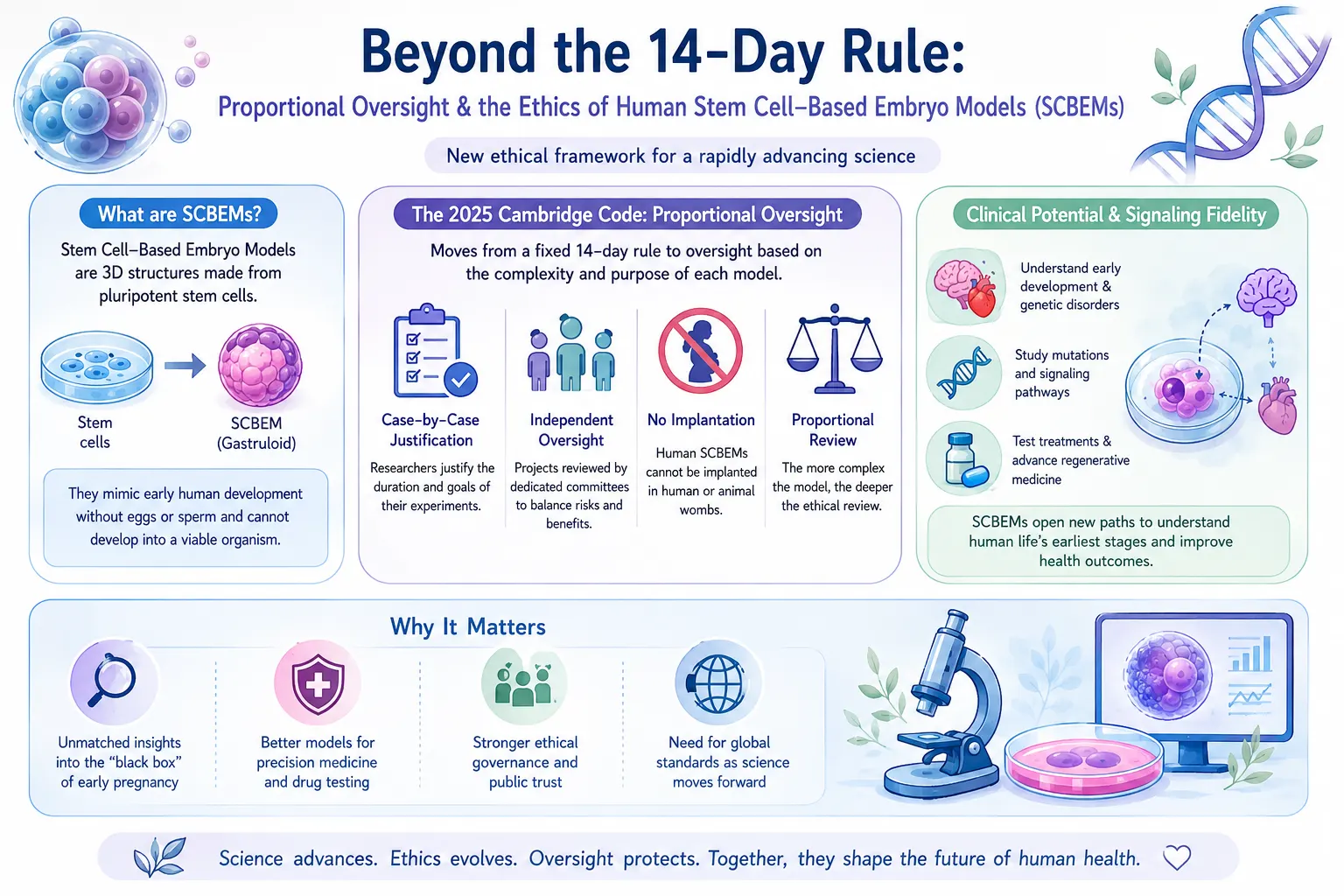
For nearly four decades, the "14-day rule"—which prohibits the culture of human embryos beyond the point of primitive streak formation—has served as the primary ethical boundary for embryological research. However, the rule was originally established at a time when maintaining an embryo in vitro for 14 days was technically impossible; it was, as some bioethicists argue, a "ruse" that outlawed what could not yet be done. In 2024 and 2025, the emergence of human Stem Cell-Based Embryo Models (SCBEMs), also known as "synthetic embryos" or "gastruloids," has fundamentally challenged this framework.
These models are 3D biological structures created by the self-organization of pluripotent stem cells. They mimic critical aspects of early human development—including axis formation, symmetry breakage, and the initial foundations of the brain and heart—without the involvement of eggs or sperm. Because SCBEMs are not derived from fertilization and currently lack the potential to develop into a viable organism, they have existed in a legal and ethical vacuum. To address this, the University of Cambridge, in partnership with the Progress Educational Trust, released the first-ever "Code of Practice for the Generation and Use of Human Stem Cell-Based Embryo Models" in February 2025.
The 2025 Cambridge Code: Proportional Oversight
The 2025 Cambridge Code represents a departure from arbitrary time limits in favor of a "proportional oversight" model. Recognizing that SCBEMs vary significantly in their complexity—ranging from simple gastruloids to "integrated models" that contain extraembryonic tissues like the yolk sac or placenta precursors—the Code dictates that the level of ethical review must be proportionate to the biological complexity of the model.
Key provisions of the 2025 framework include
Case-by-Case Justification: Instead of a hard 14-day cutoff, researchers are required to provide a clear scientific and ethical justification for the duration of their experiments. Dedicated Oversight Committees: Every project involving organized human SCBEMs must be reviewed by an independent committee that balances the potential for medical breakthrough (e.g., treating recurrent miscarriage or infertility) against ethical sensitivities. Prohibition of Implantation: The Code maintains a strict "red line" prohibiting any human SCBEM from being transferred into a human or animal womb, ensuring these structures remain strictly tools for in vitro research.
Clinical Potential and Signaling Fidelity
The primary value of SCBEMs lies in their ability to provide "unmatched insights" into the first weeks of pregnancy, a period often called the "black box" of human life. Recent research published in Nature and Cell has demonstrated that these models can accurately replicate the effects of specific genetic mutations on brain and heart development. For example, by mimicking the signaling exchanges between embryonic and extraembryonic tissues, researchers identified the Wnt ß-catenin pathway as a central regulator of neural tube defects.
Furthermore, SCBEMs derived from patient-specific induced pluripotent stem cells (iPSCs) offer a safer and more compatible platform for testing regenerative medicine treatments, potentially avoiding the immunogenicity issues associated with traditional cell therapies. For academics, the challenge for 2026 is ensuring "developmental faithfulness"—improving the structural accuracy of these models while maintaining transparent communication with a public that often equates "synthetic" with "artificial" or "unnatural." As the technology moves toward gestating these models in "pregnant organoids" that mimic the uterine lining, the need for a robust, international regulatory framework has never been more urgent.
References
1. Cambridge Reproduction. (2025). Code of practice for the generation and use of human stem cell-based embryo models. University of Cambridge.
2. Rivron, N., et al. (2025). Stem cell and synthetic embryo models: Advances, applications, and ethical considerations. ResearchGate.
3. Smith, W. J. (2026). How far will experiments on the unborn go? Science and Culture.
No comments yet. You can leave the first one.