
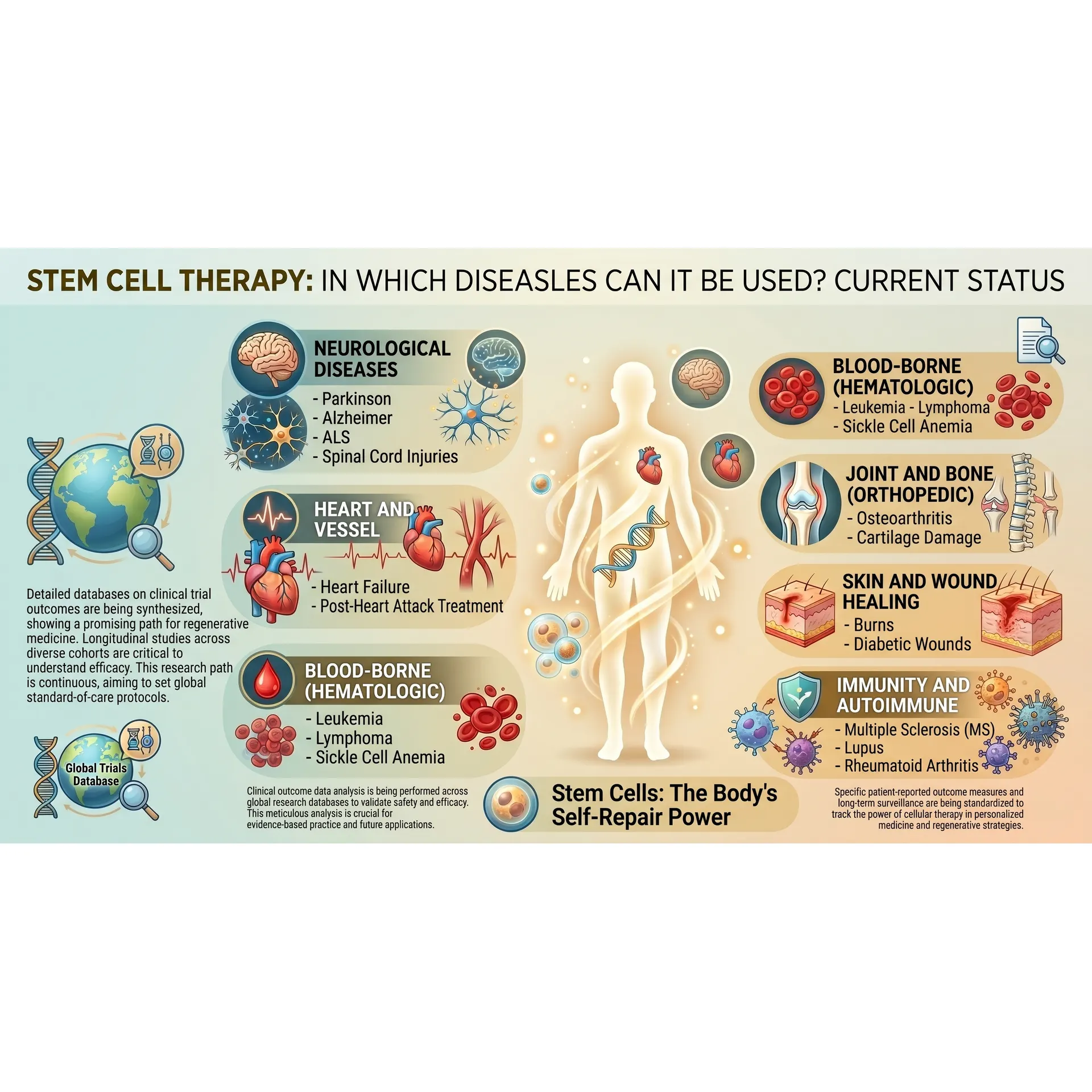
Throughout medical history, humanity has pursued one monumental dream: to replace or repair a damaged, aging, or diseased organ just like replacing a part in a car. For decades, this concept was confined to the realms of science fiction. Today, however, thanks to stem cell therapy and regenerative medicine, that dream has moved out of the laboratory and into the hospital—into real life.
Yet, a quick internet search on stem cells reveals a massive wave of information pollution. From cancer to anti-aging aesthetics, paralysis to baldness, it is often marketed as a "miracle cure" for everything. But what do we actually know based on concrete science? Which diseases are currently treated with stem cells as a standard, approved medical practice, and which ones are still strictly in the "experimental" phase?
Let’s take a futuristic yet deeply realistic journey into the world of these master cells and look at the most up-to-date status in modern medicine.
What is a Stem Cell? (The Cellular Jokers)
Before diving into specific treatments, let's understand why stem cells are so extraordinarily unique using a simple analogy. Stem cells are the "joker cells" or the raw materials of the human body.Most other cells in our body (such as a cell in your eye, your heart muscle, or your skin) have a highly specific, fixed identity. When they divide, they can only replicate themselves; a liver cell cannot suddenly transform into a neuron (brain cell). Stem cells, however, are unprogrammed blank slates. They possess two incredible capabilities:
- Self-Renewal: They can divide repeatedly to maintain a steady pool of stem cells.
- Differentiation: Depending on the signals they receive, they can transform into specialized cells, such as a heart muscle cell, a bone cell, a red blood cell, or a neuron.
- This is the exact power modern medicine seeks to harness: sending these cellular jokers directly to a damaged area to initiate an authentic, deep repair process.
Today's Reality: Currently Approved and Standard Treatments
While stem cell therapy is often discussed as a technology of tomorrow, it has actually been a routine, life-saving reality in medicine for nearly 50 years through bone marrow transplantation (Hematopoietic Stem Cell Transplantation).Today, the standard use cases officially approved by global health authorities (like the FDA and EMA) include:
- Blood and Lymph Cancers (Leukemia, Lymphoma, Multiple Myeloma)
- Bone Marrow Failures and Severe Blood Disorders
- Primary Immune Deficiency Disorders
Tomorrow's Promise: Diseases in Clinical Trial Phases
Now let's look at the other side of the coin: the conditions frequently featured in sensational headlines like "Stem Cells Allow Paralyzed Patient to Walk Again!" While these studies are incredibly exciting, they are currently in the clinical trial and research phase, meaning they are not yet standard, universally approved treatments:- Neurodegenerative Diseases (Parkinson's, Alzheimer's, ALS)
- Type 1 Diabetes
- Heart Attacks and Cardiovascular Disease
- Spinal Cord Injuries and Paralysis
Stem Cells in Aesthetics and Orthopedics: Science vs. Marketing
Currently, two fields heavily market stem cell procedures commercially: stem cell facial rejuvenation and knee osteoarthritis (joint calcification) treatments.- Orthopedics: Injecting cells harvested from a patient's own body fat (Stromal Vascular Fraction - SVF) or bone marrow into a painful knee joint is highly effective at suppressing local inflammation and providing significant pain relief. However, it is crucial to manage expectations: this procedure does not magically rebuild a completely eroded cartilage layer back to how it was when you were 18.
- Aesthetics: Cosmetic skin treatments usually utilize fibroblast or mesenchymal-derived stem cells. They effectively trigger collagen production and revitalize skin elasticity, but they are an optimization tool, not a mythical "fountain of youth" that halts aging permanently.
The Next Frontier: Artificial Organs and iPSCs
One of the most jaw-dropping advancements in this field is iPSC (Induced Pluripotent Stem Cell) technology, which won the Nobel Prize in 2012. Scientists can now take an ordinary, mature skin cell from your body and genetically program it backward into an embryonic-like stem cell state.The implications for the future are staggering. Eventually, without ever needing embryonic tissue, physicians could potentially use your own skin cells to 3D-bioprint a perfectly matched heart, kidney, or liver. The risk of organ rejection would drop to absolute zero because the organ would be made entirely from your own genetic material.
Conclusion: Cautious Optimism on the Path to Miracles
Stem cell therapy represents arguably the most powerful key in history to unlocking treatments for chronic diseases that modern medicine has deemed incurable. In hematology, it already saves thousands of lives daily. For organ failures and nervous system damage, science is moving forward with massive strides.The most critical takeaway for patients and families is to remain vigilant against "hope merchants." Avoid unverified, "under-the-table" clinics offering unproven stem cell therapies that have not completed formal phase trials, lack peer-reviewed data, or operate without proper regulatory oversight from health ministries. Authentic science is on the right track, and in the foreseeable future, our cellular jokers will rewrite the textbook of medicine.
References
- Biehl, J. K., & Russell, B. (2009). Introduction to stem cell therapy. The Journal of Cardiovascular Nursing, 24(2), 98-103. https://doi.org/10.1097/JCN.0b013e318197a6a5
- Yamanaka, S. (2012). Induced pluripotent stem cells: past, present, and future. Cell Stem Cell, 10(6), 678-684. https://doi.org/10.1016/j.stem.2012.05.005
- Zakrzewski, W.,elt;Aniszewska, M., Szymonowicz, M., & Rybak, Z. (2019). Stem cells: past, present, and future. Stem Cell Research & Therapy, 10(1), 1-22. https://doi.org/10.1186/s13287-019-1165-5
No comments yet. You can leave the first one.