
The Arctic Ocean is one of the most sensitive barometers of global climate change, particularly regarding the stability of its vast methane hydrate reservoirs. Methane (CH_4) has more than 25 times the warming impact of carbon dioxide, and its release from the seafloor could trigger a catastrophic feedback loop. In 2024 and 2025, the discovery and subsequent monitoring of the Freya Hydrate Mounds—the deepest cold seeps ever recorded—have provided an "ultra-deep natural laboratory" for studying these processes in real-time. This surveillance utilizes a multimodal approach, combining high-resolution acoustic tracking with metagenomic analysis of the water column to quantify the fate of escaping gas.
Multimodal Surveillance: Acoustic Signatures of the Abyss
Quantifying methane release from seeps 3,640 meters below the surface is a daunting technical challenge. In 2025, researchers successfully deployed hydrophones on the ocean floor to listen to the "acoustic signature" of the seeping gas. Methane bubbles make distinct noises as they squeeze through seafloor sediment and escape into the water column. The hydrophone recordings revealed that the Freya mounds release gas in "short, high-frequency bursts" occurring in clusters of 2–3 seconds.
By analyzing the intensity and frequency of these bursts, scientists can calculate the volume of gas being emitted. Unlike shallow-water seeps where bubbles burst at the surface, at the extreme depths of the Molloy Ridge, most methane is expected to be "digested" by methanotrophic microbes or dissipated before it reaches the atmosphere. However, as Arctic waters warm, the stability of these hydrates is decreasing, and the goal of the acoustic surveillance is to detect early signs of a "methane surge" that could disrupt global climate models. Metagenomic snapshots of the water column confirm that these deep-sea "oases" support a high density of biomass, with community structures strikingly similar to the Jøtul hydrothermal vent field.
Genomic Tracking of the "Methane Eaters"
The second pillar of surveillance is the analysis of the microbial communities that consume the escaping methane. Utilizing 13C Stable Isotope Probing (SIP) combined with metagenomics, researchers have identified a suite of Gammaproteobacteria and archaea that rapidly respond to methane inputs. In the Arctic plumes of the Gakkel Ridge (e.g., Polaris and Aurora), these microbes fix inorganic carbon at rates up to 46 µmol m-3 day-1, significantly higher than in background deep water.
A key finding from the 2025 Arctic Deep expedition is that while hydrogen and sulfide are the dominant energy sources in many vent plumes, the cold seeps like Freya are uniquely dependent on methane and thermogenic hydrocarbons (ethane, propane, and butane). By documenting the "transcriptional signature" of these microbes, researchers can "track" how the community structure shifts as environmental conditions change. For instance, a 25% increase in the relative abundance of the SUP05 cluster serves as a genomic indicator of elevated chemical flux.
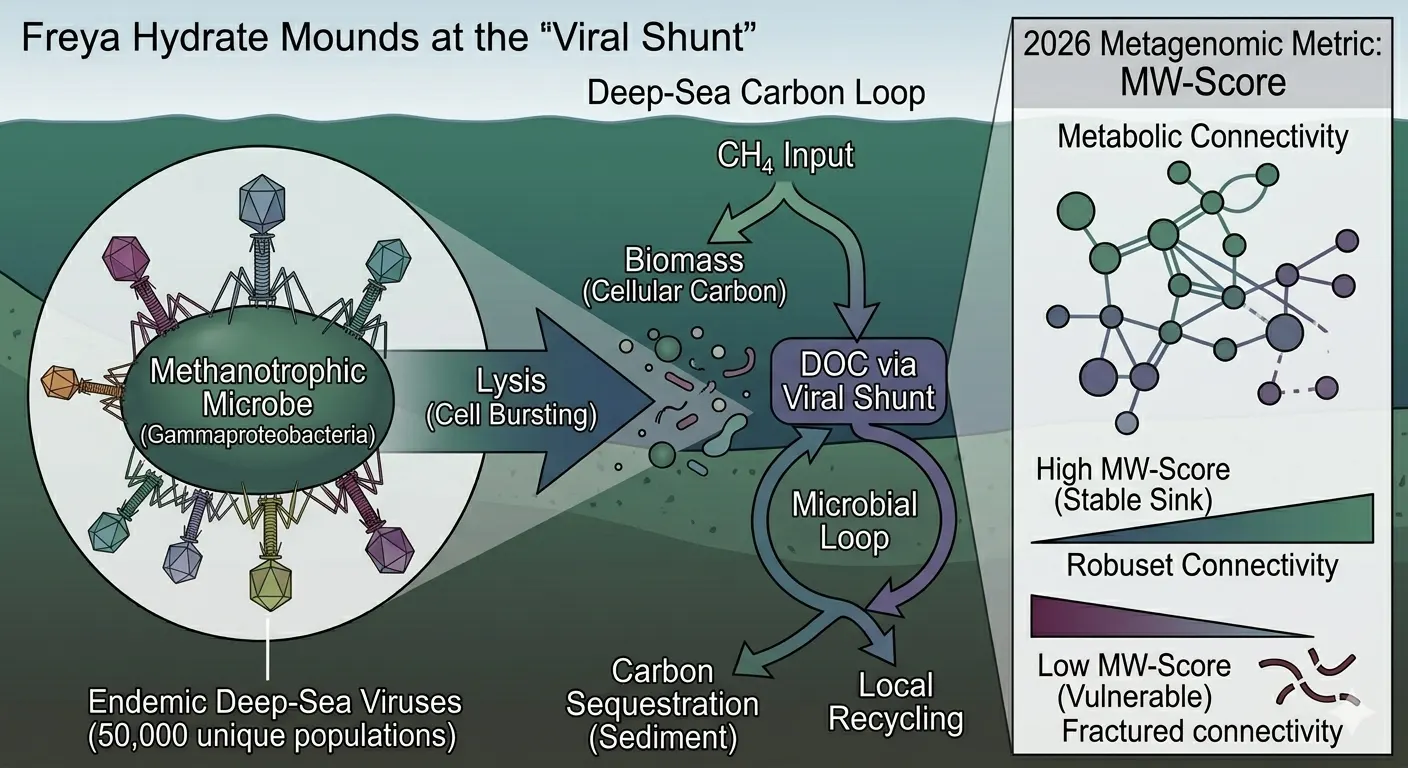
The efficiency of these deep-sea carbon sinks is further modulated by the "viral shunt." In these ultra-deep environments, viruses infect the primary producers (the methanotrophs), causing them to burst (lysis) and release organic carbon back into the dissolved pool. This process fuels the "microbial loop" and determines whether the carbon is sequestered in the sediment or recycled locally. Metagenomic reconstructions have identified nearly 50,000 unique viral populations in these habitats, many of which are endemic and highly adapted to specific geological signatures.
Looking ahead to 2026, the focus will be on calculating the MW-score—a measure of metabolic connectivity—for these deep-sea communities. This score will help scientists predict how deep-sea mining or climate-driven temperature increases might disrupt the delicate balance of these Arctic methane sinks. For academics in ecology and biogeochemistry, the Freya Hydrate Mounds are no longer just geological curiosities; they are central players in the Earth’s climate stability, and their ongoing surveillance is a scientific imperative.
References
1. Abbaszade, M., et al. (2025). The emergence of artificial intelligence in molecular biology: A structural review. Structural Biology Reviews.
2. Apostolou, E., & Apostolou, E. (2025). Mitotic chromatin organization and the maintenance of gene activity. Nature Reviews Molecular Cell Biology.
3. Bengtsson, F., et al. (2025). Scientists found climate change hidden in old military air samples. Journal of Ecology.
4. Chen, R., Li, X., & Cao, B. (2025). The future of DNA storage in revolutionizing biological data management. Journal of Artificial Intelligence in Bioinformatics, 1(2), 51–57.
5. Cronberg, N., & Stenberg, P. (2025). DNA from wind-dispersed biological particles as an archive of ecological change. Lund University Research Portal.
6. Dubovitskii, V., et al. (2025). Advancing single-cell omics and cell-based therapeutics with quantum computing. Nature Reviews Molecular Cell Biology.
7. Erb, T. J., & Luo, S. (2024). Construction and modular implementation of the THETA cycle for synthetic CO2 fixation. Nature Catalysis.
8. Georgiadis, M., et al. (2025). Micron-resolution fiber mapping in histology independent of sample preparation. Nature Communications.
9. Huso, V. L., et al. (2025). ZAK activation at the collided ribosome. Nature.
10. Joye, S. B., et al. (2025). Elevated heterotrophic activity in hydrothermal plumes and the viral shunt. Nature Communications.
11. Krüger, N., et al. (2025). Semaglutide and tirzepatide in patients with heart failure and preserved ejection fraction. JAMA.
12. Luo, E., & Trubl, G. (2025). Viral impacts on microbial carbon cycling at deep-sea hydrothermal vents. ISME Journal.
13. Maher, J. L., III, et al. (2025). Unbiased cell culture selections to identify senescent cell-specific folded DNA aptamers. Aging Cell.
14. Menzel, M., et al. (2025). Milestone in mapping the brain's nerve fibre labyrinth using ComSLI. Nature Communications.
15. Panieri, G., et al. (2025). The discovery of the Freya Hydrate Mounds: Paradigms of deep-sea Arctic ecosystems and the carbon cycle. Nature Communications.
16. Ruetz, T. J., et al. (2024). CRISPR-Cas9 screens reveal regulators of ageing in neural stem cells. Nature, 634, 1150-1159.
17. Singer, Z. S., & Danino, T. (2025). Coordinated activity of prokaryote and picornavirus for safe intracellular delivery (CAPPSID). Nature Biomedical Engineering.
18. Speight, R., & Wiskich, A. (2024). The decarbonisation potential of engineering biology. Global Change Biology.
19. Yue, F., et al. (2026). A hidden world inside DNA is finally revealed: Detailed 3D maps of the human genome. Nature.
No comments yet. You can leave the first one.