
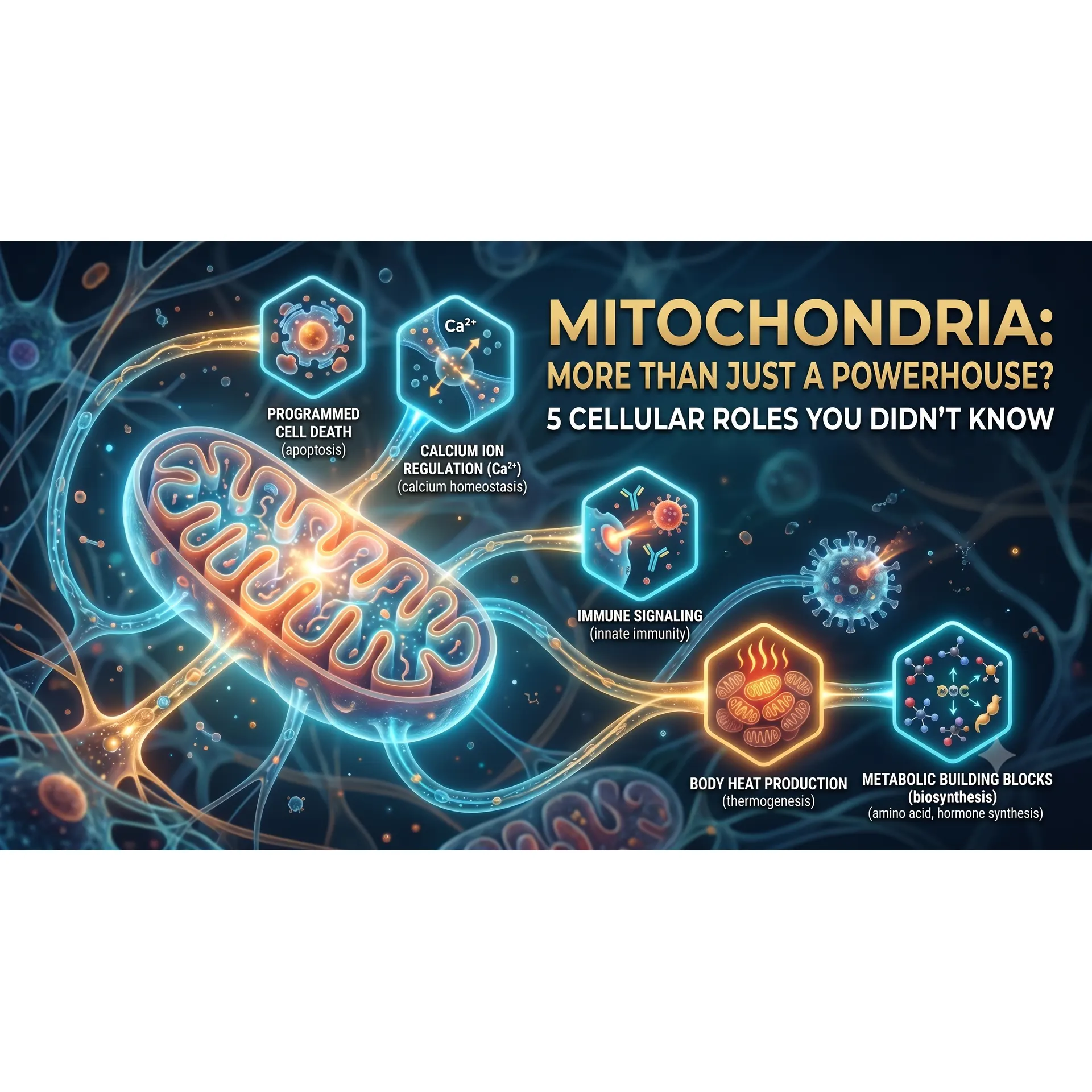
Remember that famous sentence we memorized like a nursery rhyme in biology class: "The mitochondrion is the powerhouse of the cell." This definition is certainly not wrong; yes, they use the food we eat and the oxygen we breathe to produce ATP (ATP), the energy currency our cells can spend. But let’s be honest, viewing the mitochondrion merely as a "generator" is like using a smartphone solely as a "calculator."
Cellular biology research over the past two decades shows that these double-membrane organelles do not just sit in the cell's kitchen—they sit on the board of directors. Our mitochondria determine the fate of the cell, manage our immune system, regulate the rate of aging, and even communicate with each other by establishing a secret intercellular internet network.
Are you ready to dive deeper into this mysterious world inside your cells and discover 5 vital cellular functions of the mitochondrion that go far beyond "generating energy"—ones you have probably never heard of before?
Master of Cellular Fate: Programmed Cell Death (Apoptosis)
Who decides when a cell should die? Although it sounds a bit chilling, it is necessary for certain cells to commit suicide in a planned manner for a healthy body. We call this process apoptosis (programmed cell death). For example, the fading of the webs between our fingers while we are still in the womb, or the elimination of aged, DNA-damaged, cancer-prone cells occurs thanks to apoptosis.
The executioner of this critical decision is none other than the mitochondrion. When a cell receives irreversible damage or ages, the outer membrane of the mitochondrion becomes permeable. The mitochondrion leaks a special protein called Cytochrome c (Cytochrome\ c), which it stores inside, into the cell plasma (cytosol). This leakage acts as a "self-destruct" button within the cell. Cytochrome c triggers molecular scissors called caspases, and the cell is neatly packaged and eliminated without harming surrounding tissues. What happens if the mitochondrion fails to perform this duty? The cell continues to live when it should die, which directly leads to tumor and cancer formation.
The Hidden Vault of Calcium and Cellular Balance
Calcium (Ca^2+) is not just an important mineral for our bones; it is the most aggressive and crucial signaling messenger inside the cell. From the contraction of our muscles to the communication between neurons, almost everything depends on intracellular calcium levels. However, an excess of free-floating calcium inside the cell is toxic. Therefore, calcium must be tightly controlled.
This is where the mitochondrion steps in, working hand-in-hand with the endoplasmic reticulum. When calcium levels inside the cell spike suddenly, the mitochondrion acts like a sponge and pulls the excess calcium into itself. When needed, it releases this calcium back in precise, millimetric doses. Without this calcium-buffering capacity of the mitochondrion—especially in the rhythmic contraction of our heart and at the synaptic points where memories are formed in our brain—cellular chaos would ensue.
The Early Warning Radar of the Immune System
We know that billions of years ago, mitochondria were primitive bacteria that entered into a symbiotic relationship (endosymbiosis) with our cells during the evolutionary process. This origin has brought an incredible fact to light in modern medicine: mitochondria still act a bit like bacteria and talk directly to our immune system!
When a cell is invaded by a virus or bacteria, or when it undergoes severe stress, mitochondria become damaged and release their own internal DNA (mtDNA) into the cell. The cell's immune receptors recognize this circular mitochondrial DNA just like a foreign bacterial invasion and trigger an alarm. Through special proteins called MAVS (Mitochondrial Antiviral Signaling), the mitochondrion commands the cell to initiate antiviral defense mechanisms. In other words, the mitochondrion works like a hidden radar inside the cell, signaling the immune system: "We are under attack, produce interferon!"
Thermogenesis: The Hidden Fire That Warms the Body
When you go outside in the winter or stay in cold weather, what do you owe the stability of your body temperature around 36.5°C to? Mitochondrial heat production, of course—namely, thermogenesis.
"Brown adipose tissue," which is abundant in newborns and hibernating mammals, is completely packed with mitochondria, and it is the mitochondrion itself that gives this tissue its brown color. These specialized mitochondria contain a protein called UCP1 (Uncoupling Protein 1 / Thermogenin). This protein sabotages the proton motive force that the mitochondrion would normally use to produce ATP (energy) and converts this energy directly into heat. In short, the mitochondrion stops being the cell's power plant and suddenly transforms into a cellular heater, protecting us from freezing.
The Production Factory of Metabolic Intermediates
Where do you think amino acids, hormones, and the "heme" molecule (the part of hemoglobin) that gives our blood its red color are produced? Yes, you guessed it right: mostly inside the mitochondrion.
The mitochondrion is not just a furnace that burns glucose into ashes. It is a massive chemical factory where the building blocks necessary for the survival and growth of the cell are synthesized. The Krebs cycle (citric acid cycle) inside the mitochondrion is not just a stepping stone for energy production; it is also a logistics center providing raw materials for the cell to manufacture its own proteins, lipids, and nucleic acids (DNA/RNA fragments). If the mitochondrion stops working, the cell cannot structurally renew itself.
Conclusion: The Conductor of the Cellular Orchestra
As you can see, defining the mitochondrion merely as a "powerhouse" does it a great injustice. It is a regulator managing intracellular calcium, an immune sentinel sensing danger, a heater warming the body, a judge drawing the fate of the cell, and a biochemical factory.
The next time you feel tired, work out, or take a deep breath, remember that you are not just storing energy; trillions of tiny conductors inside your body are working hard to synchronize your life. A healthy life, clean eating, and regular exercise are essentially nothing more than taking good care of these tiny friends.
References (APA 7th Edition)
- Chandel, N. S. (2014). Navigating metabolism. Cold Spring Harbor Laboratory Press.
- Galluzzi, L., Kepp, O., & Kroemer, G. (2012). Mitochondria: Master regulators of danger signalling. Nature Reviews Molecular Cell Biology, 13(12), 780-788. https://doi.org/10.1038/nrm3479
- Nunnari, J., & Suomalainen, A. (2012). Mitochondria: In sickness and in health. Cell, 148(6), 1145-1159. https://doi.org/10.1016/j.cell.2012.02.035
- Rizzuto, R., De Stefani, D., Raffaello, A., & Mammucari, C. (2012). Mitochondria as sensors and regulators of calcium signalling. Nature Reviews Molecular Cell Biology, 13(9), 566-578. https://doi.org/10.1038/nrm3412
- West, A. P., Shadel, G. S., & Ghosh, S. (2011). Signaling to innate immunity by mitochondrial DNA and reactive oxygen species. Nature Reviews Immunology, 11(6), 389-402. https://doi.org/10.1038/nri2982

No comments yet. You can leave the first one.