
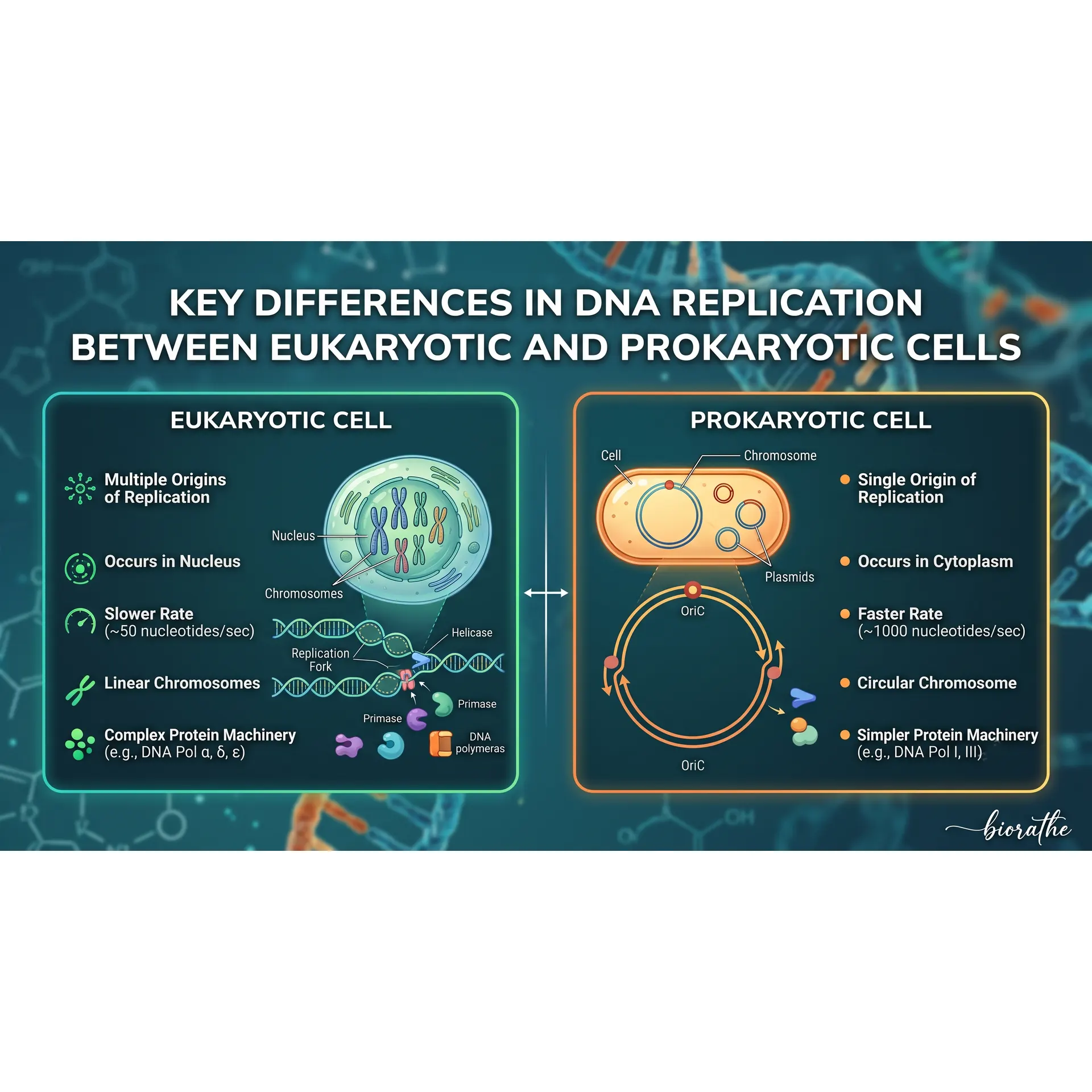
One of the most fascinating aspects of life is the immense information-transfer mechanism operating in microscopic worlds. Whether you are a complex human being made of trillions of cells or a simple bacterium living in a single drop of water, survival and the continuation of your lineage rely on one golden rule: replicating DNA flawlessly.
In biology, we call this DNA replication. At first glance, the process seems identical: the double helix unwinds, complementary letters (nucleotides) line up, and two brand-new DNA molecules are born. However, when we dive into the details, we see that prokaryotes (bacteria and archaea) and eukaryotes (us, plants, fungi, and all advanced life forms) manage this journey with entirely different strategies. These differences are not just academic trivia; they are the ultimate proof of how life evolved from simplicity to complexity.
Architectural Differences: Studio Apartment vs. Multi-Story Mansion
Before diving into the depths of replication, we must look at the structural environments of these two cell types. What directly dictates how replication is carried out is where and how the DNA is packaged. The interior design of the cell directly limits or expands the working space of enzymes.
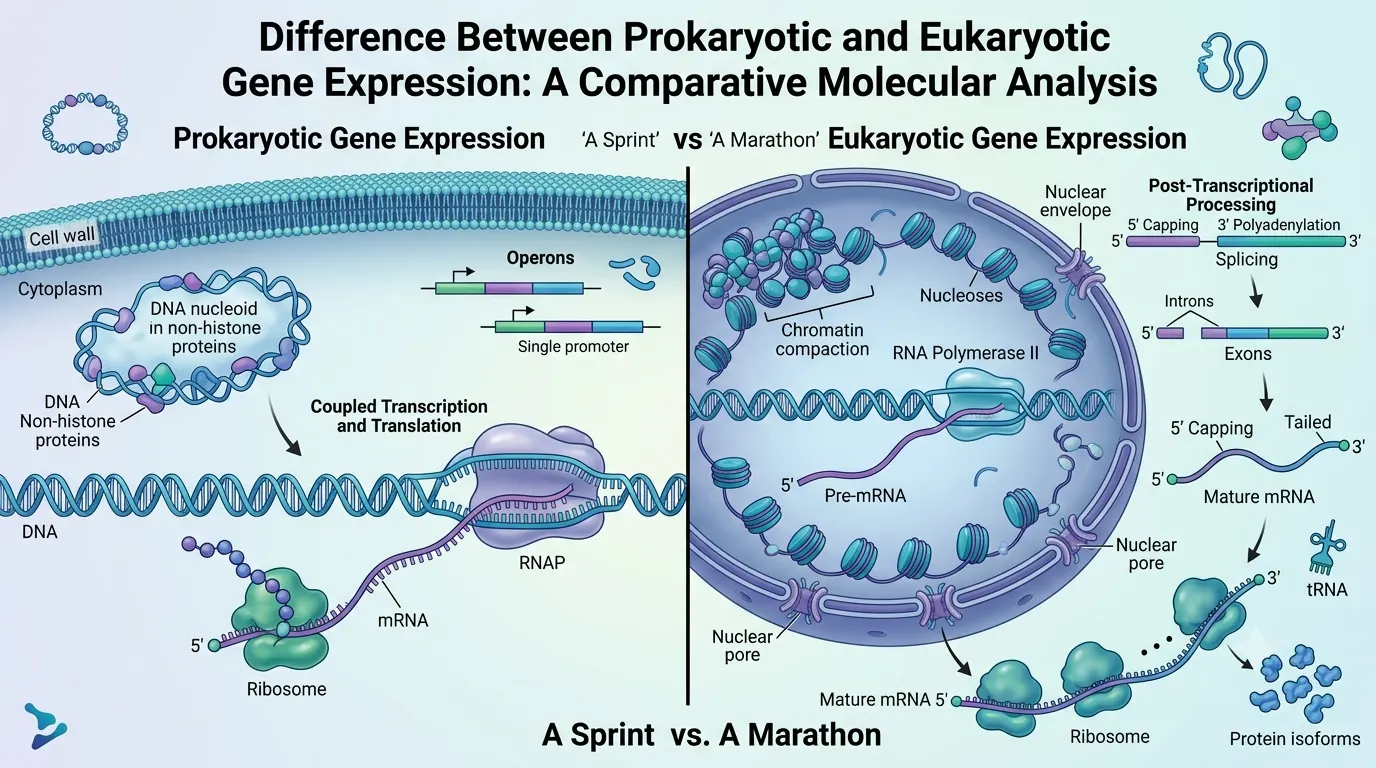
- Prokaryotes (The Studio Apartment): These cells do not have a protective room called a nucleus. Everything shares the same single space. Their DNA is circular, floats freely in the cytoplasm in a region called the "nucleoid," and is not wrapped around histone proteins. The layout is extremely simple. When the cell receives a division signal, the replication team goes straight to the target because there are no protein barriers to overcome.
- Eukaryotes (The Multi-Story Mansion): Here, DNA is safely locked inside a dedicated control room (the nucleus). Furthermore, it is linear and tightly wrapped around proteins called histones, forming massive, folded packages called "chromatin." This intricate architecture makes the replication team’s job incredibly difficult. Enzyymes cannot just replicate DNA; they must first unpack these massive bundles and then repack them flawlessly once the process is complete.
1. Starting Points (Origins of Replication)
Imagine you are photocopying a book. The prokaryotes' book is thin and consists of a single page. The eukaryotes' book is a multi-volume encyclopedia set. Naturally, the two systems adopt completely different starting strategies.
- In Prokaryotes: There is a single starting point (oriC) on the circular DNA. Replication begins here, proceeds bidirectionally (in both directions), and terminates on the opposite side of the circle at a specific termination (ter) region. A single "origin" is more than enough to replicate this small, circular molecule.
- In Eukaryotes: Linear DNA is so incredibly long that if replication started from a single point, a single cell division would take days, if not weeks. To prevent this fatal bottleneck, thousands of replication origins activate simultaneously along eukaryotic DNA. Replication begins at hundreds of different sites at once, and these replication "bubbles" eventually merge to complete the process in a matter of hours (usually 6 to 8 hours).
2. The Copying Crew: The Battle of DNA Polymerases
The star player of replication is the DNA Polymerase enzyme, which acts like a bricklayer adding nucleotides one by one to synthesize the new strand. However, the "labor class" employed by each cell group and their areas of expertise are quite distinct.
Prokaryotic Polymerases
In prokaryotes, things are run pragmatically with fewer personnel. Three main polymerases do most of the heavy lifting:
- DNA Polymerase III: The site manager. This is the primary enzyme that synthesizes the new strand by adding nucleotides. It possesses an extraordinary synthesis capacity.
- DNA Polymerase I: It removes the temporary RNA primers placed at the beginning of synthesis and fills the remaining gaps with actual DNA nucleotides.
- DNA Polymerase II: It primarily steps in during emergencies to repair DNA damage.
Eukaryotic Polymerases
In eukaryotes, there is full departmentalization and specialization. While more than 15 polymerases have been identified, the major giants in replication are:
- Polymerase Alpha: Responsible for initiating replication. Working closely with the primase enzyme, it synthesizes the initial RNA primer followed by a very short stretch of DNA.
- Polymerase Delta: Synthesizes the lagging strand. It also features an advanced proofreading mechanism to check for and correct errors behind the replication fork.
- Polymerase Epsilon: The main workhorse that synthesizes the leading strand at high speed.
3. Speed and the Size of Okazaki Fragments
There is an unchanging balance in nature: the more complex a job is and the more security checks it undergoes, the slower it progresses.
- Prokaryotes are Fast and Furious: Prokaryotic replication is literally jet-fueled. Approximately 1000 nucleotides are added per second. Since the DNA is not wrapped around histone proteins, there are no obstacles in front of the polymerase; it races down an empty highway. Due to this high speed, the Okazaki fragments (discontinuous pieces) synthesized on the lagging strand are quite long, measuring about 1000 to 2000 nucleotides in length.
- Eukaryotes are Slow but Cautious: In eukaryotes, the speed is only about 50 nucleotides per second. This is because there are nucleosomes (histon packages) along the way, and it takes time for polymerases to bypass these obstacles. Furthermore, they cannot afford mistakes; a eukaryotic mutation can lead to cancer or immediate cell death. Because of this cautious drive, Okazaki fragments are much shorter: about 100 to 200 nucleotides.
4. The Telomere Dilemma (The Struggle at the End of the Line)
Running on a circular track means you will never reach "the end of the road" and fall off. But if you are running in a straight line, you eventually hit the end and must stop. This is where the most dramatic mechanical difference between linear and circular DNA lies.
- In Prokaryotes, There is No End: When circular DNA is replicated, the start and end points merge perfectly. The replication fork circles the entire molecule, the two rings separate, and no genetic information is lost.
- In Eukaryotes, the Ends Melt Away: When the RNA primer at the very end of linear DNA is removed, there is no "3'-OH" group available for a polymerase to fill the gap. Consequently, with each round of replication, the ends of chromosomes shorten slightly. Without a safeguard, the cell would begin losing vital genes every time it divided. To solve this aging and information-loss problem, eukaryotes place non-coding, repetitive sequences called telomeres at the chromosome ends. As the cell divides, these telomeres shorten instead of functional genes. Cancer cells and stem cells use a specialized enzyme called telomerase to continually rebuild and extend these ends.
References
- Alberts, B., Heald, R., Johnson, A., Morgan, D., Raff, M., Roberts, K., & Walter, P. (2022). Molecular biology of the cell (7th ed.). W. W. Norton & Company.
- Cooper, G. M. (2022). The cell: A molecular approach (9th ed.). Oxford University Press.
- Garg, P., & Burgers, P. M. (2005). How eukaryotic DNA polymerases coped with DNA replication. Critical Reviews in Biochemistry and Molecular Biology, 40(2), 115-128. https://doi.org/10.1080/10409230590935479
- Kornberg, A., & Baker, T. A. (1992). DNA replication (2nd ed.). W. H. Freeman and Company.
- Langer, M. R., Blais, S. P., & Bell, S. P. (2020). Mechanisms of eukaryotic DNA replication initiation. Annual Review of Biochemistry, 89(1), 159-187. https://doi.org/10.1146/annurev-biochem-011520-105211
- Lodish, H., Berk, A., Kaiser, C. A., Krieger, M., Bretscher, A., Ploegh, H., Amon, A., & Martin, K. C. (2021). Molecular cell biology (9th ed.). W. H. Freeman and Company.
- Nelson, D. L., & Cox, M. M. (2021). Lehninger principles of biochemistry (8th ed.). Macmillan Learning.
- O'Donnell, M., Langston, L., & Stillman, B. (2013). Principles and concepts of DNA replication in bacteria, archaea, and eukarya. Cold Spring Harbor Perspectives in Biology, 5(7), a010108. https://doi.org/10.1101/cshperspect.a010108
- Reece, J. B., Urry, L. A., Cain, M. L., Wasserman, S. A., Minorsky, P. V., & Jackson, R. B. (2020). Campbell biology (12th ed.). Pearson.
- Sclafani, R. A., & Holzen, T. M. (2007). Cell cycle regulation of DNA replication. Annual Review of Genetics, 41(1), 237-280. https://doi.org/10.1146/annurev-genet.41.110306.130308
No comments yet. You can leave the first one.