
One of the fundamental rules of life in classical biology is simple: parents pass their genes down to their offspring. We call this "vertical gene transfer." Humans, animals, and plants have evolved under this rule for millions of years. However, in the microscopic world, a completely different game is played. Bacteria can rewrite the rules of evolution by casually swapping genetic material with their peers or even entirely different bacterial species.
This process, known as Horizontal Gene Transfer (HGT), is the master key that explains how bacteria acquire antibiotic resistance so rapidly, adapt to harsh environments overnight, and give rise to deadly superbugs. Bacteria execute this genetic exchange primarily through three distinct pathways: Transformation, Transduction, and Conjugation.
In this comprehensive guide for Biorathe, we step through these three powerful mechanisms of microbiology, breakdown their mechanics step-by-step, and explore their evolutionary impact.
1. Transformation: The Art of Scavenging Foreign DNA
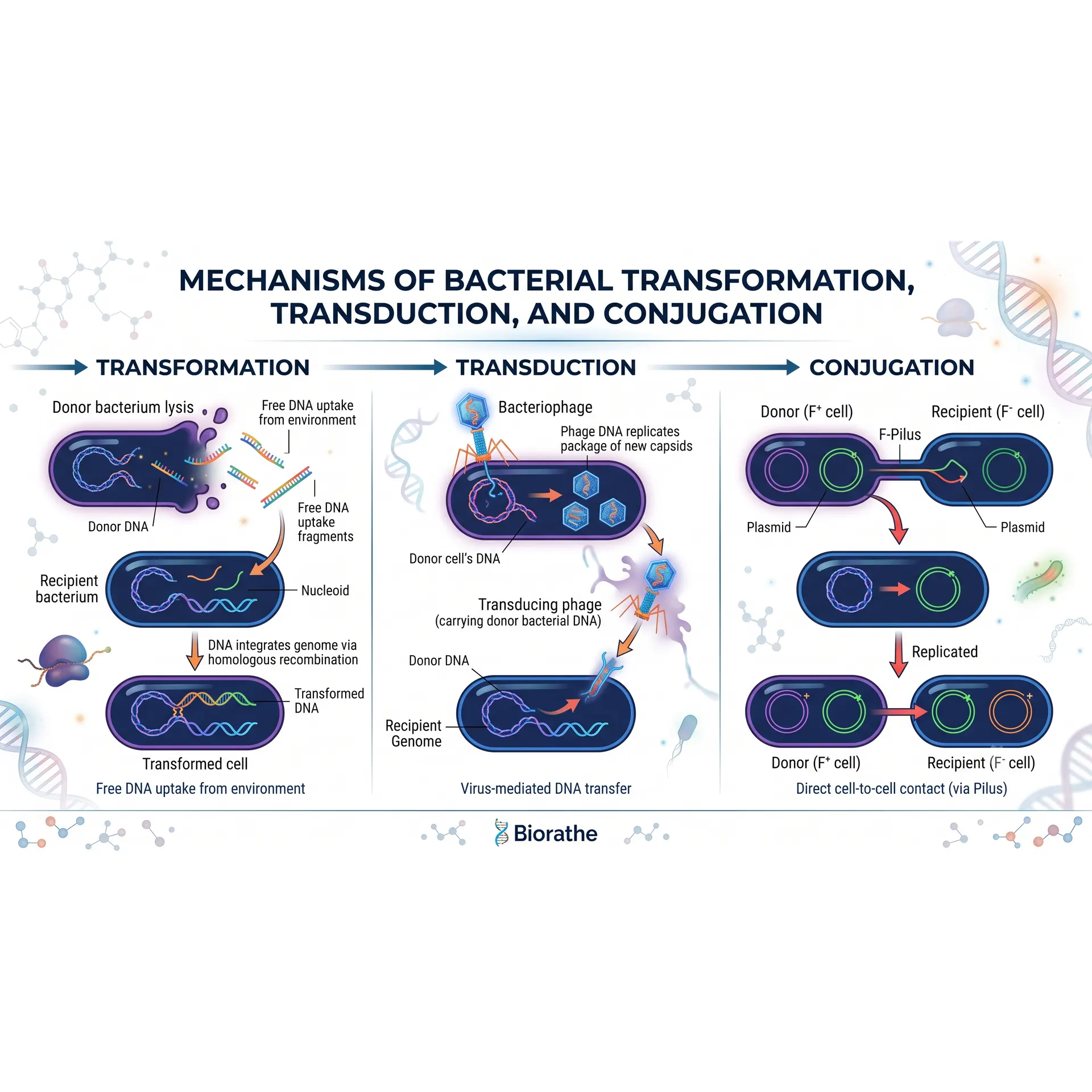
Transformation is the process by which a bacterium takes up free, naked DNA fragments from its surrounding environment and integrates them into its own genome. This phenomenon was first discovered in 1928 by Frederick Griffith through his famous experiment with Streptococcus pneumoniae. Griffith observed that non-virulent bacteria could acquire "something" from heat-killed virulent bacteria and transform into deadly pathogens themselves. That "something" was later proven to be DNA.
How Does the Mechanism Work?
When a bacterial cell dies and lyses, its genomic contents spill into the surrounding environment. However, a bacterium cannot simply absorb any piece of passing DNA whenever it wants. To take up extracellular DNA, a bacterium must enter a physiological state known as competence.
- Competence and Binding: The bacterium expresses specialized surface receptors and transport complexes (typically Type IV pilus-like structures). Double-stranded DNA in the environment binds to these surface receptors.
- DNA Uptake: As the DNA is pulled through the cell envelope, membrane-bound nucleases degrade one of the strands. Consequently, only a single-stranded DNA (ssDNA) molecule enters the cytoplasm.
- Homologous Recombination: Once inside, this foreign single strand pairs with a complementary region on the host chromosome. A key protein named RecA mediates the integration of this single strand into the bacterial genome. If the incorporated sequence confers a survival benefit—such as antibiotic resistance—the transformed bacterium gains a brand-new trait.
Naturally competent species include Neisseria, Streptococcus, and Bacillus. In the laboratory, non-competent species like E. coli are made artificially competent through calcium chloride treatment or electroporation (electric shock).
2. Transduction: The Viral Delivery Service
Transduction is the virus-mediated transfer of bacterial DNA from one cell to another. In this process, bacteriophages (viruses that infect bacteria) accidentally act as molecular couriers. The host bacterium plays no active role in seeking out DNA; it simply becomes the beneficiary of a viral packaging error.
Transduction occurs in two distinct forms: Generalized and Specialized Transduction.
A) Generalized Transduction
This mechanism occurs during the lytic cycle of virulent phages:
- A bacteriophage infects a host bacterium and hydrolyzes the host’s chromosome into small fragments.
- During the assembly of new viral particles, a packaging mistake occurs: the viral machinery mistakenly packages a fragment of the host bacterial DNA into the viral capsid instead of the phage genome.
- When this "defective" phage infects a new recipient bacterium, it injects the previous bacterium's DNA instead of viral genes.
- The recipient cell survives the infection because no viral genes were introduced, and it integrates the incoming bacterial DNA into its own chromosome, gaining new traits.
B) Specialized Transduction
This mechanism occurs during the lysogenic cycle of temperate phages:
- The phage integrates its genome into a specific site on the bacterial chromosome (becoming a prophage).
- Upon induction (e.g., due to environmental stress), the prophage excises itself from the host chromosome. If an imprecise excision occurs, the phage carries a specific adjacent bacterial gene along with its own viral DNA.
- When these hybrid phages infect new host cells, they transfer that specific set of bacterial genes (such as toxin genes). The ability of Corynebacterium diphtheriae to produce the dangerous diphtheria toxin is a classic example of specialized transduction.
3. Conjugation: Bacterial "Sex" and the Physical Bridge
Conjugation is the direct transfer of genetic material—typically plasmids—between two bacterial cells in physical contact. Although bacteria reproduce asexually, conjugation is often nicknamed bacterial "sex" because genetic material moves directly from a donor cell to a recipient cell.
The F Plasmid and the Sex Pilus
For conjugation to take place, the donor bacterium must carry the F plasmid (Fertility factor).
- F⁺ Cell: The donor cell that carries the F plasmid.
- F⁻ Cell: The recipient cell that lacks the F plasmid.
Step-by-Step Conjugation Mechanism:
- Establishing Contact: The F⁺ donor projects a specialized protein filament called a Sex Pilus (F pilus), attaches to the F⁻ recipient, and retracts to bring the two cells together, forming a conjugative bridge.
- Nicking the DNA: The double-stranded F plasmid is nicked at a specific site called the origin of transfer (oriT) by a specialized enzyme called relaxase.
- Single-Strand Transfer (Rolling Circle Replication): The cleaved single strand of the plasmid unravels and passes through the conjugation bridge into the recipient cell. Simultaneously, the donor synthesizes a replacement strand using the remaining intact strand as a template (rolling circle model).
- Complementary Synthesis and Conversion: Once inside the recipient, the single strand acts as a template to synthesize a complementary strand, restoring a double-stranded circular plasmid.
- Outcome: The former F⁻ recipient is now converted into a functional F⁺ cell, capable of synthesizing its own sex pilus and initiating conjugation with other bacteria.
Hfr Strains (High Frequency of Recombination)
Occasionally, the F plasmid integrates directly into the host bacterium's main chromosome. Cells with an integrated F plasmid are called Hfr cells. When an Hfr cell initiates conjugation, it attempts to transfer its entire main chromosome along with the integrated F factor. Because the conjugation bridge usually breaks before the lengthy chromosome can completely pass through, the recipient receives key chromosomal genes but rarely receives the complete F factor required to become F⁺.
References
- Alberts, B., Heald, R., Johnson, A., Morgan, D., Raff, M., Roberts, K., & Walter, P. (2022). Molecular biology of the cell (7th ed.). W. W. Norton & Company.
- Bushman, F. (2002). Lateral gene transfer: Antibiotic resistance, disinfectants, and DNA genomics. Cold Spring Harbor Laboratory Press.
- Chen, I., & Dubnau, D. (2004). DNA transport during transformation. Nature Reviews Microbiology, 2(3), 241-249. https://doi.org/10.1038/nrmicro845
- Grohmann, E., Muth, G., & Espinosa, M. (2003). Conjugative plasmid transfer in gram-positive bacteria. Microbiology and Molecular Biology Reviews, 67(2), 277-301. https://doi.org/10.1128/mmbr.67.2.277-301.2003
- Madigan, M. T., Bender, K. S., Buckley, D. H., Sattley, W. M., & Stahl, D. A. (2021). Brock biology of microorganisms (16th ed.). Pearson.
- Pena, A., & Mellado, R. P. (2018). Mechanisms of bacterial gene transfer: Transformation, transduction, and conjugation. Journal of Bacteriology & Virology, 48(4), 112-125.
- Snyder, L., Peters, J. E., Henkin, T. M., & Champness, W. (2013). Molecular genetics of bacteria (4th ed.). ASM Press.
- Thomas, C. M., & Nielsen, K. M. (2005). Mechanisms of, and barriers to, horizontal gene transfer between bacteria. Nature Reviews Microbiology, 3(9), 711-721. https://doi.org/10.1038/nrmicro1234
- Virolle, M. J., Goldlust, A., & Chen, J. (2020). Horizontal gene transfer in bacteria: Mechanisms, regulation, and implications for antibiotic resistance spread. Frontiers in Microbiology, 11, 590028. https://doi.org/10.3389/fmicb.2020.590028
- Willetts, N., & Wilkins, B. (1984). Processing of plasmid DNA during bacterial conjugation. Microbiological Reviews, 48(1), 24-41. https://doi.org/10.1128/mr.48.1.24-41.1984
No comments yet. You can leave the first one.