
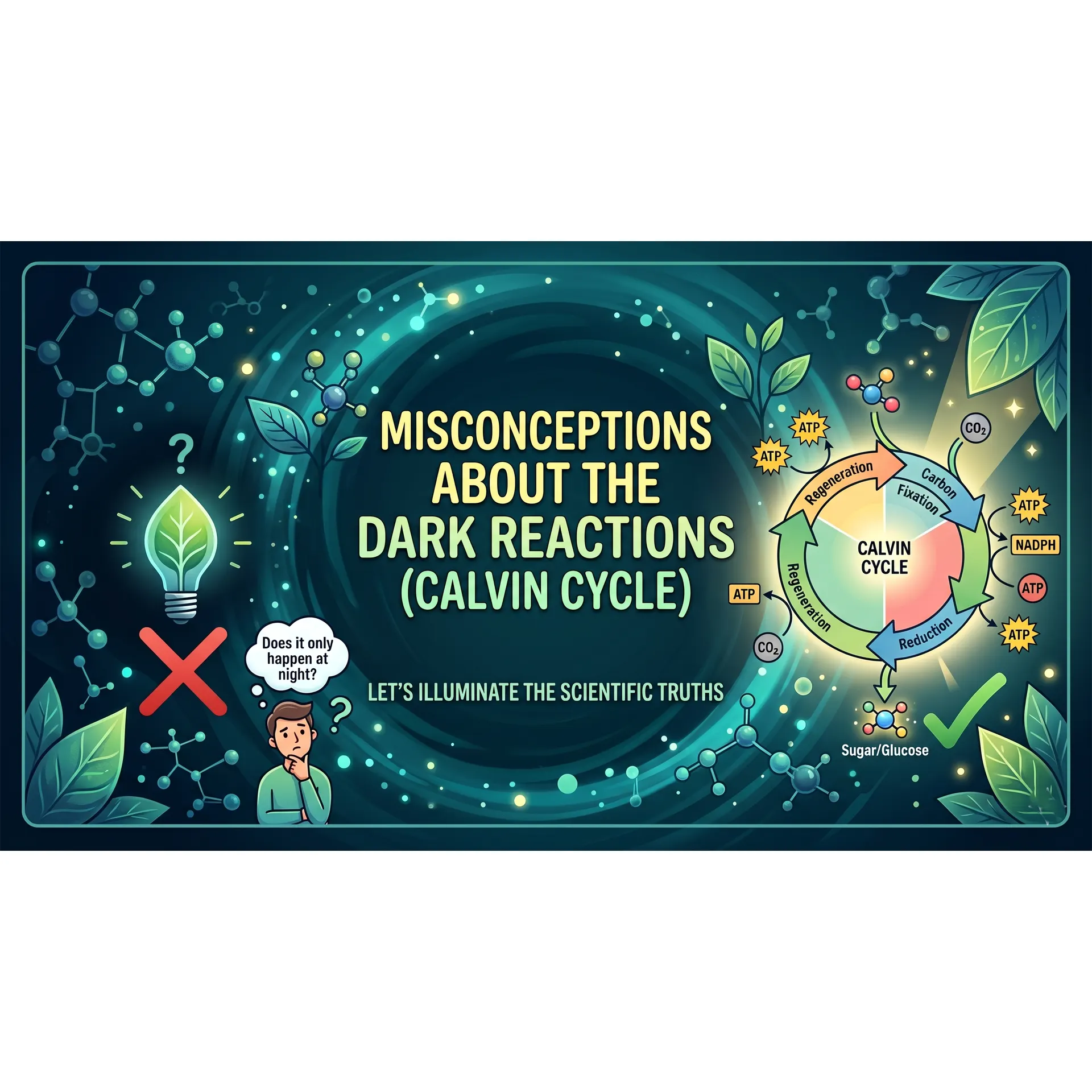
There is a classic photosynthesis diagram engraved in our minds since secondary school biology: the leaf absorbs sunlight and splits water molecules during the light reaction; then night falls, and the plant utilizes carbon dioxide to manufacture sugars in the dark reaction.
If you believe that the second phase of photosynthesis occurs exclusively at night, shrouded in pitch-black darkness, you are not alone. However, biologically speaking, you are the victim of a massive, widespread scientific misconception.
As modern plant physiology and biochemistry peel back the molecular realities driving the carbon fixation pathways of the Calvin Cycle, it has become blatantly clear how much confusion obsolete terminology has caused. Let's dismantle the 5 biggest myths surrounding this magnificent biological cycle and analyze the true cellular mechanics.
Myth 1: "The Dark Reaction Only Occurs in the Dark or at Night"
This is the most persistent and widespread error in photosynthesis education. The reaction cascade was historically termed the "Dark Reaction" for one reason only: its enzymes do not directly capture or use photons (sunlight) as a substrate. Unlike the light-dependent reactions, it does not require the direct excitation of chlorophyll electrons.
The Reality
The Calvin Cycle operates during the day, in full light. In fact, if a plant is plunged into complete darkness, the cycle grinds to a halt within a few minutes. This happens due to two primary biological factors:
- Raw Material Dependency: To fix carbon dioxide into sugar, the Calvin Cycle requires a non-stop supply of ATP and NADPH. These energy currencies are manufactured exclusively during the preceding light-dependent reactions. When a plant enters darkness, ATP and NADPH production ceases, starving the Calvin Cycle of its fuel.
- Light-Activated Enzymes: The most critical enzymes of the cycle—especially Rubisco—have evolved to remain dormant unless the chloroplast stroma is exposed to light. Under illumination, the stroma experiences an influx of magnesium (Mg2+) ions and a sharp increase in pH. This specific chemical shift acts as the structural "on" switch for the enzymes. In the dark, they slip back into an inactive sleep mode.
To prevent this systemic confusion, modern biological literature has heavily phased out the term "Dark Reaction," replacing it with "Light-Independent Reactions" or "Carbon Fixation Pathways."
Myth 2: "The Direct Product of the Calvin Cycle is Glucose"
When writing down the summary equation for photosynthesis, almost everyone balances the right side with C6H12O6 (Glucose). While this overarching equation offers a neat chemical summary, it completely masks the actual output running inside the chloroplast stroma.
The Reality
The Calvin Cycle never releases a free, unattached glucose molecule as an immediate product. The authentic, direct end-product of the cycle is G3P (Glyceraldehyde 3-Phosphate), a 3-carbon sugar phosphate.
The G3P molecules that exit the cycle are subsequently exported to the cytoplasm or modified within the stroma to build glucose, sucrose (transport sugar), starch (storage sugar), cellulose, or even amino acids and fatty acids based on the plant's immediate metabolic needs. The Calvin Cycle is not a glucose factory; it is a structural workshop synthesizing the 3-carbon bricks (G3P) that form the baseline of all organic life.
Myth 3: "Rubisco is a Flawless, High-Speed Masterpiece of an Enzyme"
In the initial step of the Calvin Cycle, inorganic CO2 is captured and spliced onto the 5-carbon sugar RuBP. This reaction is catalyzed by Rubisco (Ribulose-1,5-bisfosfat karboksilaz/oksijenaz). Given that the heart of global organic chemistry rests on this enzyme, you might assume it is a highly evolved, high-velocity molecular machine.
The Reality
From a biochemical standpoint, Rubisco is one of the slowest, most inefficient, and structurally confused enzymes nature ever engineered.
- The Velocity Deficit: While a typical metabolic enzyme can catalyze thousands of reactions per second, a single Rubisco molecule can only fix 3 to 5 molecules of carbon dioxide per second. To compensate for this sluggish pace, plants produce staggering quantities of it. Rubisco makes up roughly 30% to 50% of the soluble protein content in a leaf, earning it the title of the most abundant single protein on Planet Earth.
- The Identity Crisis (Photorespiration): Rubisco struggles to distinguish carbon dioxide (CO2) from molecular oxygen (O2). If oxygen levels climb inside the leaf tissue, Rubisco accidentally binds to O2 instead of CO2. This kicks off a pathway called Photorespiration—an evolutionary disaster that forces the plant to waste precious ATP and shed previously fixed carbon without producing any sugar. Plants (specifically C4 and CAM lineages) had to spend millions of years evolving complex anatomical workarounds just to fix the structural mistakes of this clumsy enzyme.
The standardized Calvin Cycle taught in basic biology textbooks describes C3 Photosynthesis, where CO2 is fixed directly, and the very first stable intermediate is a 3-carbon molecule. This gives rise to the misconception that every green plant drives this cycle in the exact same cellular compartment and timeframe.
Myth 4: "All Photosynthetic Plants Run the Calvin Cycle in the Exact Same Way"
The standardized Calvin Cycle taught in basic biology textbooks describes C3 Photosynthesis, where CO2 is fixed directly, and the very first stable intermediate is a 3-carbon molecule. This gives rise to the misconception that every green plant drives this cycle in the exact same cellular compartment and timeframe.
The Reality
Plants occupying arid, hot, or resource-limited climates have radically altered the implementation of the Calvin Cycle to escape water loss and Rubisco's oxygen vulnerability.
- C4 Plants: They split carbon capture and the Calvin Cycle spatially (by location). They capture CO2 inside Mesophyll cells using an enzyme impervious to oxygen, convert it into a 4-carbon acid, and pump it deep into tightly sealed Bundle Sheath cells. Rubisco is kept isolated inside these inner cells, flooded with pure CO2 away from oxygen, where it runs the Calvin Cycle with maximum efficiency.
- CAM Plants: They separate the steps temporally (by time). To avoid drying out in scorching heat, they keep their stomata tightly sealed all day. At night, they open their stomata to breathe in CO2, storing it safely inside vacuoles as malic acid. When the sun comes up, they keep their stomata closed, release the stored carbon internally, and run the Calvin Cycle using fresh ATP and NADPH supplied by daytime sunlight.
Myth 5: "The Light-Independent Phase is Where Oxygen is Produced or Consumed"
Because photosynthesis is deeply synonymous with oxygen (O2) production, and because carbon dioxide enters during the light-independent phase, students frequently deduce that the gas exchange of oxygen output happens during these downstream molecular conversions.
The Reality
The Calvin Cycle has absolutely nothing to do with the generation of oxygen. The oxygen gas released by plants into our atmosphere is produced exclusively during the light-dependent reactions within the thylakoid membrane, where water molecules are shattered using light energy—a process known as Photolysis. The Calvin Cycle's job is solely to take carbon in, use up electrons from NADPH, and output organic structural building blocks; no oxygen is generated here.
Conclusion: A Cellular Symphony
The light-independent reactions of photosynthesis are not an isolated process abandoned to the darkness of night. Instead, it is a highly dynamic chemical framework running in perfect lockstep with daylight, turning volatile solar energy into tangible organic structures. Through the academic lens of Biorathe, discarding outdated terms like "dark reaction" and embracing the accurate classification of "Carbon Fixation Pathways" is the single most important step to mastering plant biochemistry.
References
- Andersson, I. (2008). Catalysis and regulation in Rubisco. Journal of Experimental Botany, 59(7), 1555-1568. https://doi.org/10.1093/jxb/ern091
- Bassham, J. A., Benson, A. A., & Melvin, C. (1950). The path of carbon in photosynthesis. Journal of Biological Chemistry, 185(2), 781-787.
- Bowes, G., Ogren, W. L., & Hageman, R. H. (1971). Phosphoglycolate production in chloroplasts and a ribulose diphosphate carboxylase oxygenase activity. Biochemical and Biophysical Research Communications, 45(3), 716-722. https://doi.org/10.1016/0006-291X(71)90476-5
- Calvin, M. (1962). The path of carbon in photosynthesis. Science, 135(3507), 879-889. https://doi.org/10.1126/science.135.3507.879
- Michelet, L., Zaffagnini, M., Morisse, S., Sparla, F., Pérez-Pérez, M. E., Francia, F., ... & Lemaire, S. D. (2013). Redox regulation of the Calvin-Benson cycle: something old, something new. Frontiers in Plant Science, 4, 470. https://doi.org/10.3389/fpls.2013.00470
- Nelson, D. L., & Cox, M. M. (2017). Lehninger principles of biochemistry (7th ed.). W. H. Freeman and Company.
- Raines, C. A., & Generation, P. (2003). The Calvin cycle revisited. Photosynthesis Research, 75(1), 1-10. https://doi.org/10.1023/A:1022421515027
- Sharkey, T. D. (2019). Discovery of the Calvin-Benson cycle of photosynthesis. Trends in Plant Science, 24(9), 783-785. https://doi.org/10.1016/j.tplants.2019.06.009
- Stern, K. R., Bidlack, J. E., & Jansky, S. H. (2008). Introductory plant biology (11th ed.). McGraw-Hill.
- Taiz, L., Zeiger, E., Møller, I. M., & Murphy, A. (2015). Plant physiology and development (6th ed.). Sinauer Associates.
No comments yet. You can leave the first one.