
Take a moment to think about what is happening inside your body right now.
As you read these words, millions of cells are dividing, repairing tissues, transporting oxygen, fighting infections, and performing countless other tasks that keep you alive. Most of the time, these processes happen so smoothly that we never notice them.
The human body is often compared to a highly organized city made up of trillions of cells. Every cell has a specific role, and every cell follows a set of biological rules. But sometimes, something goes wrong. A cell stops following those rules. It continues to divide when it shouldn't, ignores signals to stop growing, and begins to act independently.
This is where cancer begins.
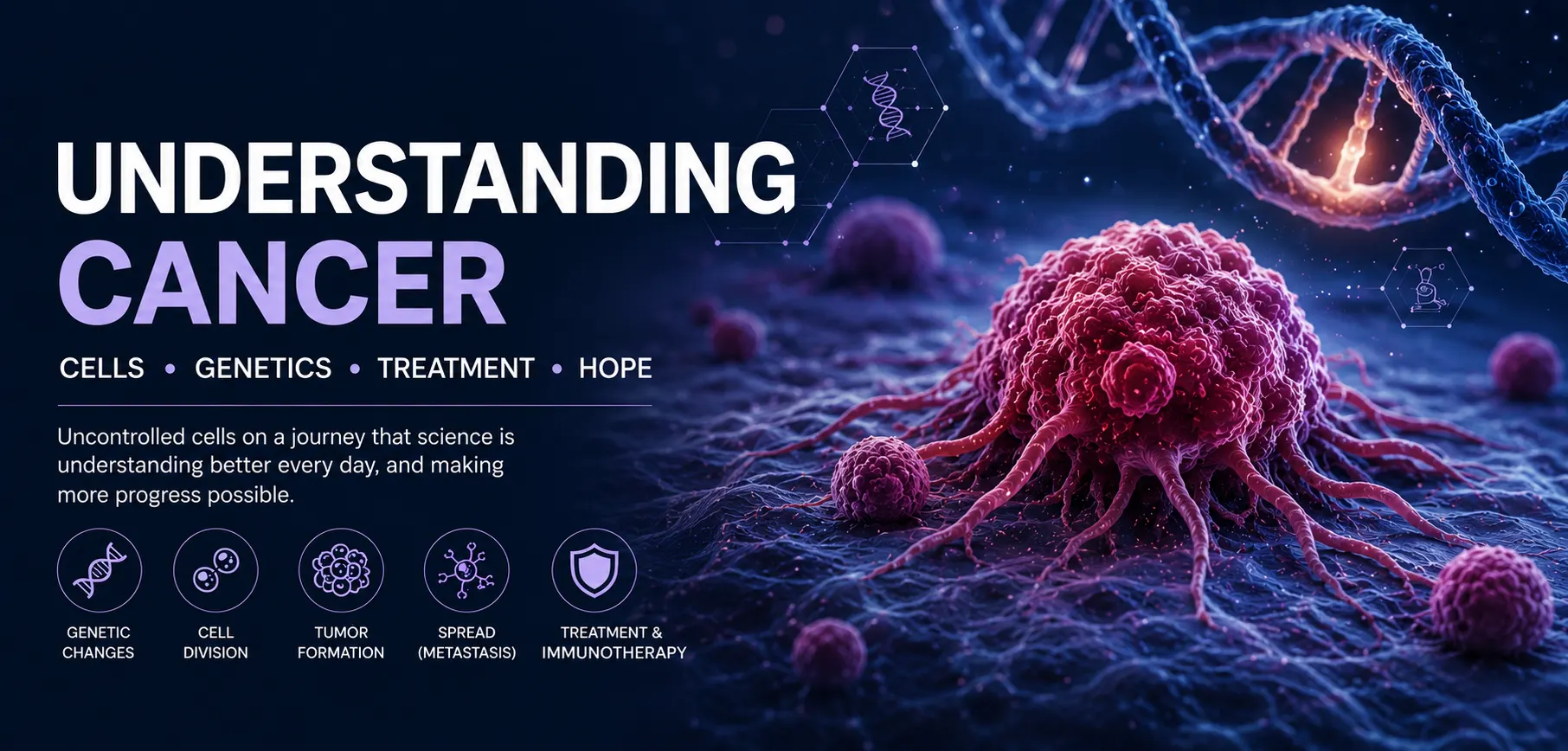
Cancer is one of the most studied diseases in modern medicine, yet it remains widely misunderstood. Many people think of cancer as a single disease, but in reality, it is a broad group of diseases that can affect nearly any tissue or organ in the body. While lung cancer, breast cancer, leukemia, and colon cancer differ in many ways, they all share one common feature: uncontrolled cell growth.
How Do Normal Cells Behave?
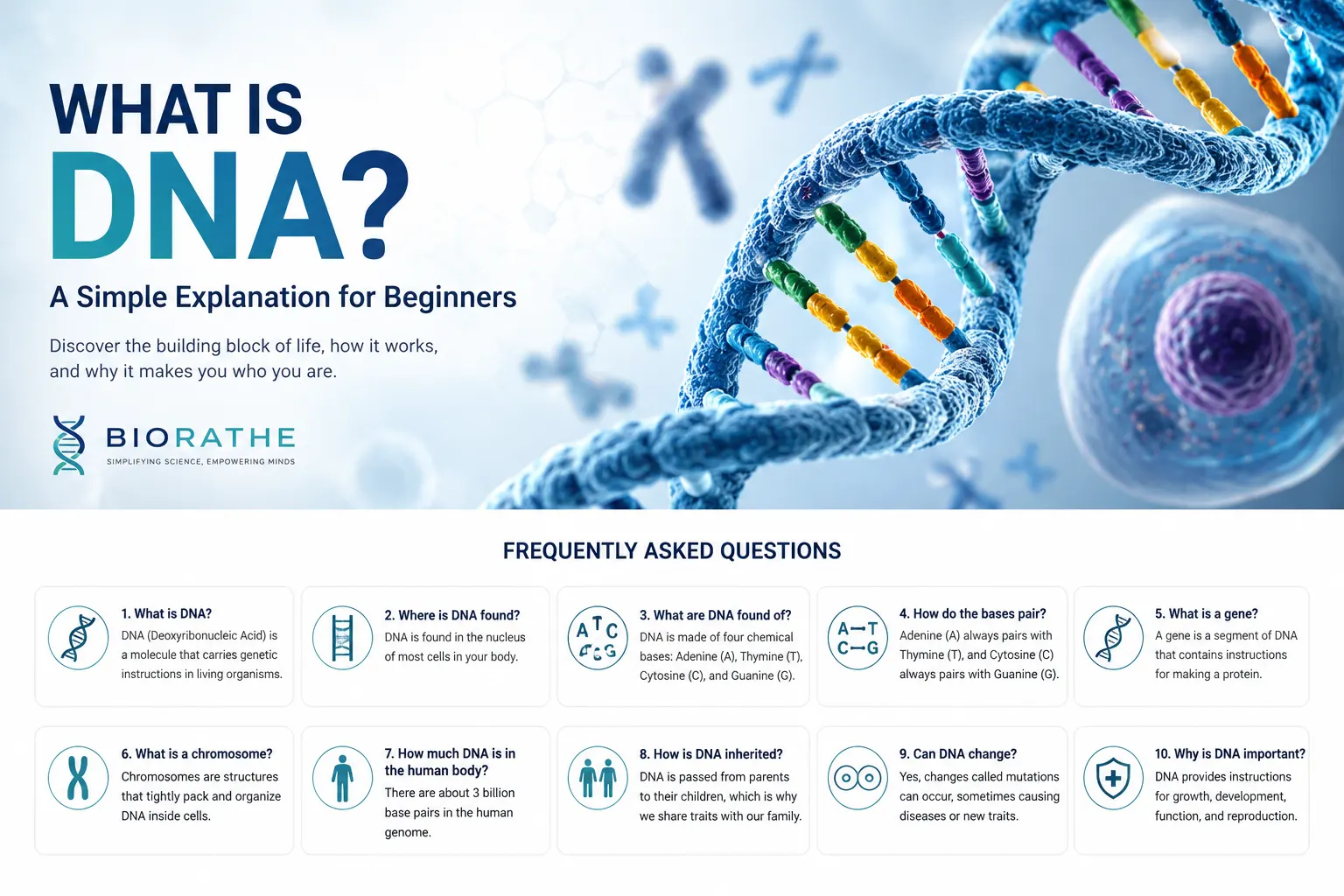
To understand cancer, it helps to first understand how healthy cells function. Every cell in the body contains DNA, the molecule that stores genetic information. DNA acts like an instruction manual, telling cells when to grow, when to divide, what proteins to produce, and when to stop functioning.
Healthy cells do not divide endlessly. They respond to signals from their environment and follow a carefully regulated life cycle. When cells become damaged, they attempt to repair themselves. If the damage is too severe, they often activate a self-destruct mechanism known as apoptosis, or programmed cell death. This system helps maintain balance within the body and prevents abnormal cells from accumulating.
The Beginning of Cancer: Changes in DNA
Cancer usually does not appear overnight. In most cases, it develops over many years as genetic changes gradually accumulate within cells. These changes are known as mutations. Mutations are actually a natural part of life. Every time a cell divides, it must copy its DNA. Considering that billions of cells divide every day, occasional errors are inevitable. Fortunately, cells possess sophisticated repair systems that correct most of these mistakes. However, some mutations escape repair. Exposure to tobacco smoke, ultraviolet (UV) radiation from the sun, certain chemicals, chronic inflammation, viral infections, and even normal aging can increase the likelihood of DNA damage. A single mutation is rarely enough to cause cancer. The disease typically develops when multiple mutations affect genes responsible for controlling cell growth and survival.
When Cells Lose Their Brakes
Imagine driving a car with a powerful engine but no brakes. Cancer cells behave in a similar way. Under normal circumstances, some genes encourage cell growth while others prevent excessive growth. Scientists often refer to these protective genes as tumor suppressor genes. Tumor suppressor genes function like the braking system of a cell. When these genes become damaged, cells may continue dividing even when they should stop.
At the same time, mutations can activate genes that stimulate growth, creating a dangerous combination. The result is a cell that ignores normal biological limits and continues multiplying. Over time, these abnormal cells accumulate and begin to form a mass.
How Do Tumors Develop?
Most cancers begin with a single abnormal cell. As that cell continues to divide uncontrollably, it produces more abnormal cells. Eventually, this growing collection of cells can form a tumor. However, not every tumor is cancerous. Benign tumors can grow in size but generally remain confined to one location and do not invade surrounding tissues. Malignant tumors, on the other hand, are cancerous. These tumors can infiltrate nearby tissues, disrupt normal organ function, and spread throughout the body. This ability to invade and spread is what makes cancer particularly dangerous.
What Is Metastasis?
One of the defining characteristics of cancer is its ability to spread beyond its original location. This process is called metastasis. Cancer cells can break away from the primary tumor and travel through the bloodstream or lymphatic system. Once they reach a distant organ, they may establish new tumors. For example, breast cancer cells can spread to the bones, liver, lungs, or brain. Similarly, lung cancer can metastasize to several other organs. In many cases, metastatic disease is responsible for the most serious complications associated with cancer.
Is Cancer Always Inherited?
A common misconception is that cancer is always passed down through families. While cancer is fundamentally a genetic disease because it involves changes in DNA, most cancers are not inherited. The majority of cancer-related mutations occur during a person's lifetime due to environmental exposures, lifestyle factors, aging, and random DNA errors. Only a relatively small percentage of cancers are directly linked to inherited genetic mutations. As a result, people with no family history of cancer can still develop the disease.
Modern Advances in Cancer Treatment
Our understanding of cancer has improved dramatically over the past few decades. Researchers can now identify specific genetic mutations driving many types of cancer, leading to more personalized treatment approaches. Today, cancer treatment may include:
Surgery
Radiation therapy
Chemotherapy
Targeted therapies
Immunotherapy
Precision medicine approaches
Among these advances, immunotherapy has generated significant excitement. Rather than attacking cancer cells directly, immunotherapy helps the body's immune system recognize and destroy cancer more effectively.
This approach has transformed treatment outcomes for several cancer types and continues to be a major focus of ongoing research.
Conclusion
Cancer is not a single disease but a complex group of disorders that arise when cells lose control over their growth and division. At the center of this process are genetic mutations that disrupt the normal mechanisms regulating cellular behavior.
Although cancer remains one of the leading causes of death worldwide, scientific progress has greatly expanded our understanding of how the disease develops. Advances in genetics, molecular biology, and biotechnology are providing researchers with powerful tools to detect, prevent, and treat cancer more effectively than ever before.
Every discovery brings us one step closer to understanding one of biology's most complex challenges—and to improving outcomes for millions of people around the world.
References
- Alberts, B., Johnson, A., Lewis, J., Morgan, D., Raff, M., Roberts, K., & Walter, P. (2022). Molecular Biology of the Cell (7th ed.). W. W. Norton & Company.
- American Cancer Society. (2025). What is cancer? Retrieved from https://www.cancer.org/cancer/understanding-cancer/what-is-cancer.html
- Hanahan, D., & Weinberg, R. A. (2011). Hallmarks of cancer: The next generation. Cell, 144(5), 646–674. https://doi.org/10.1016/j.cell.2011.02.013
- Lodish, H., Berk, A., Kaiser, C. A., Krieger, M., Bretscher, A., Ploegh, H., Amon, A., & Martin, K. C. (2021). Molecular Cell Biology (9th ed.). W. H. Freeman.
- National Cancer Institute. (2024). What is cancer? Retrieved from https://www.cancer.gov/about-cancer/understanding/what-is-cancer
- Vogelstein, B., Papadopoulos, N., Velculescu, V. E., Zhou, S., Diaz, L. A., & Kinzler, K. W. (2013). Cancer genome landscapes. Science, 339(6127), 1546–1558. https://doi.org/10.1126/science.1235122
- Weinberg, R. A. (2014). The Biology of Cancer (2nd ed.). Garland Science.
- World Health Organization. (2025). Cancer fact sheet. Retrieved from https://www.who.int/news-room/fact-sheets/detail/cancer
No comments yet. You can leave the first one.