
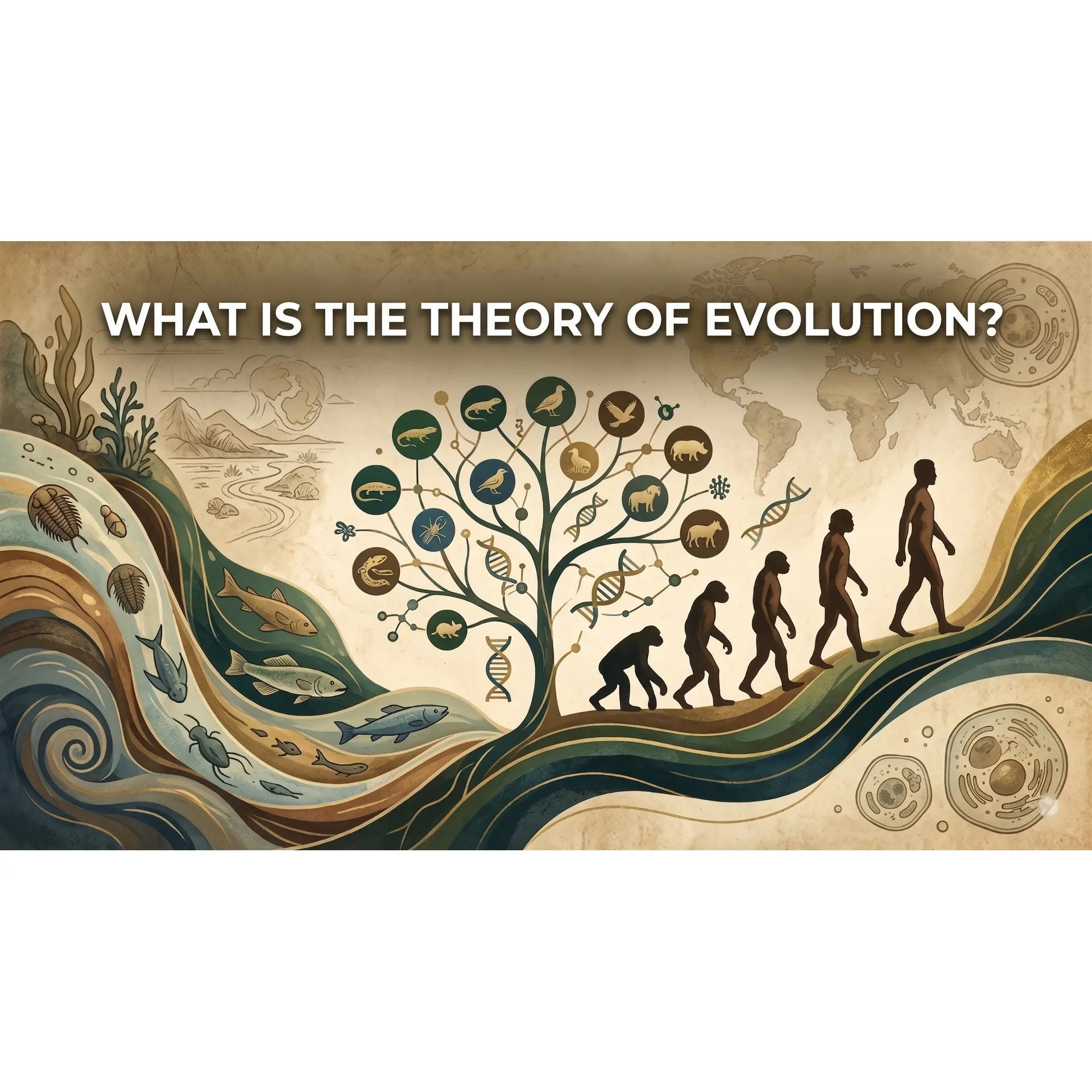
Evolutionary Theory, the most fundamental and unifying pillar of biological science, is a scientific framework that explains the diversity of life on Earth, the ancestral bonds shared by living organisms, and how they adapt to their environments. Although it is occasionally confused in popular culture with the colloquial definition of "theory"—implying a mere guess or hunch—in scientific terminology, a theory refers to an explanatory model with the highest power of clarifying phenomena, backed by a massive body of evidence, observation, and experimentation. Just like Cell Theory or the Theory of Gravitation, the Theory of Evolution is a fact agreed upon by modern science, further reinforced every day by new fossil and genetic discoveries.
This comprehensive text details the historical developmentof evolutionary biology, the fundamental mechanisms of the theory, the common ancestry of life, and the multidisciplinary evidence supporting evolution.
The Historical Development of Evolutionary Thought and the Darwinian Revolution
Contrary to popular belief, evolutionary thought did not begin with Charles Darwin. From Ancient Greek philosophers like Anaximander and Empedocles to thinkers of the Islamic Golden Age such as Al-Jahiz and Ibn Khaldun, many figures proposed ideas suggesting that organisms could change over time.
By the 18th and 19th centuries, Jean-Baptiste Lamarck put forward the idea that characteristics acquired by organisms during their lifetimes are passed on to the next generation (for example, the notion that giraffes stretched their necks and passed longer necks to their offspring). However, Lamarck’s hypothesis of the "inheritance of acquired characteristics" lost its validity with the discovery of genetic mechanisms.
The figure who built the Theory of Evolution in the modern sense and provided it with a scientific mechanism was Charles Darwin. During his five-year global voyage aboard the HMS Beagle in 1831, his observations—particularly on the finches and tortoises of the Galápagos Islands—settled the pieces of the puzzle in his mind. Darwin noticed that the beak structures of finches on different islands perfectly adapted to the food sources (seeds, insects, cacti) available on those specific islands.
Inspired by the essays of British economist Thomas Malthus on population pressure and resource scarcity, Darwin recognized a "struggle for existence" in nature. In 1859, he published his groundbreaking work, On the Origin of Species, announcing "Natural Selection"—the primary engine of evolution—to the world. Around the same time, Alfred Russel Wallace independently reached similar conclusions, and the two scientists presented the theory jointly.
The Fundamental Mechanisms of Evolution
Evolution is the change in allele (gene variations) frequencies within a population's gene pool over generations. Four fundamental mechanisms drive this change:
A. Natural Selection
Natural selection is the process by which individuals possessing traits that offer an advantage in adapting to their environment (adaptations) have higher chances of survival and reproduction. The process operates through these steps:
- Variation: Individuals within a population are not identical.
- Inheritance: A portion of these variations is transmitted to offspring via genetics.
- Overproduction and Resource Scarcity: Organisms produce more offspring than their environment can support, leading to competition.
B. Mutations
Mutations are the raw material of evolution. Random errors occurring during DNA replication or environmental factors like radiation cause changes in genetic sequences. The vast majority of mutations are neutral or harmful; however, on rare occasions, beneficial mutations emerge that provide an advantage to the organism. These beneficial mutations are favored by natural selection, spread throughout the population, and give rise to new traits.
C. Gene Flow
This is the process of transferring genetic material resulting from the migration and interbreeding of individuals between different populations. Gene flow reduces genetic differences between two distinct populations and increases intra-population diversity.
D. Genetic Drift
Genetic drift is the change in gene frequencies within a population entirely by chance (randomly). It is particularly influential in small populations. It has two common forms:
- Bottleneck Effect: The annihilation of a large portion of a population due to a disaster such as an earthquake, fire, or overhunting, leaving a small number of surviving individuals who randomly form a different gene pool.
- Founder Effect: A small group of individuals separating from the main population to colonize a new, isolated area, causing the gene pool there to develop differently from the source group.
The Modern Synthesis (Neodarwinism)
Although Darwin brilliantly explained the mechanism of evolution, he did not know exactly how traits were transmitted from generation to generation or the root origin of variation; this was because Gregor Mendel’s laws of genetics had not yet been discovered and understood by the scientific community during Darwin's time.
In the mid-20th century (the 1930s and 1940s), Darwin’s Theory of Natural Selection was merged with the principles of Mendelian Population Genetics. Shaped by the contributions of scientists like Ernst Mayr, Theodosius Dobzhansky, and Julian Huxley, this unification was named the Modern Synthetic Theory of Evolution (Modern Synthesis). Thanks to the modern synthesis, evolution became fully explainable—ranging from macro-level observations down to micro-level mathematical changes in gene frequencies.
Scientific Evidence for the Theory of Evolution
The Theory of Evolution is not monopolized by a single branch of science. Multiple independent disciplines provide mutually consistent evidence demonstrating that evolution occurs.
Scientific Evidence Fields and Explanations
Discipline / Field of Evidence: Nature of the Evidence Provided to Evolution
Paleontology (Fossil Science): Fossilized remains of organisms that lived in the past show that life evolved from simple to complex forms. In particular, "Transitional Forms" (such as Tiktaalik, which shows the transition from water to land, and Archaeopteryx, which bridges birds and dinosaurs) are concrete proof of major evolutionary transformations.
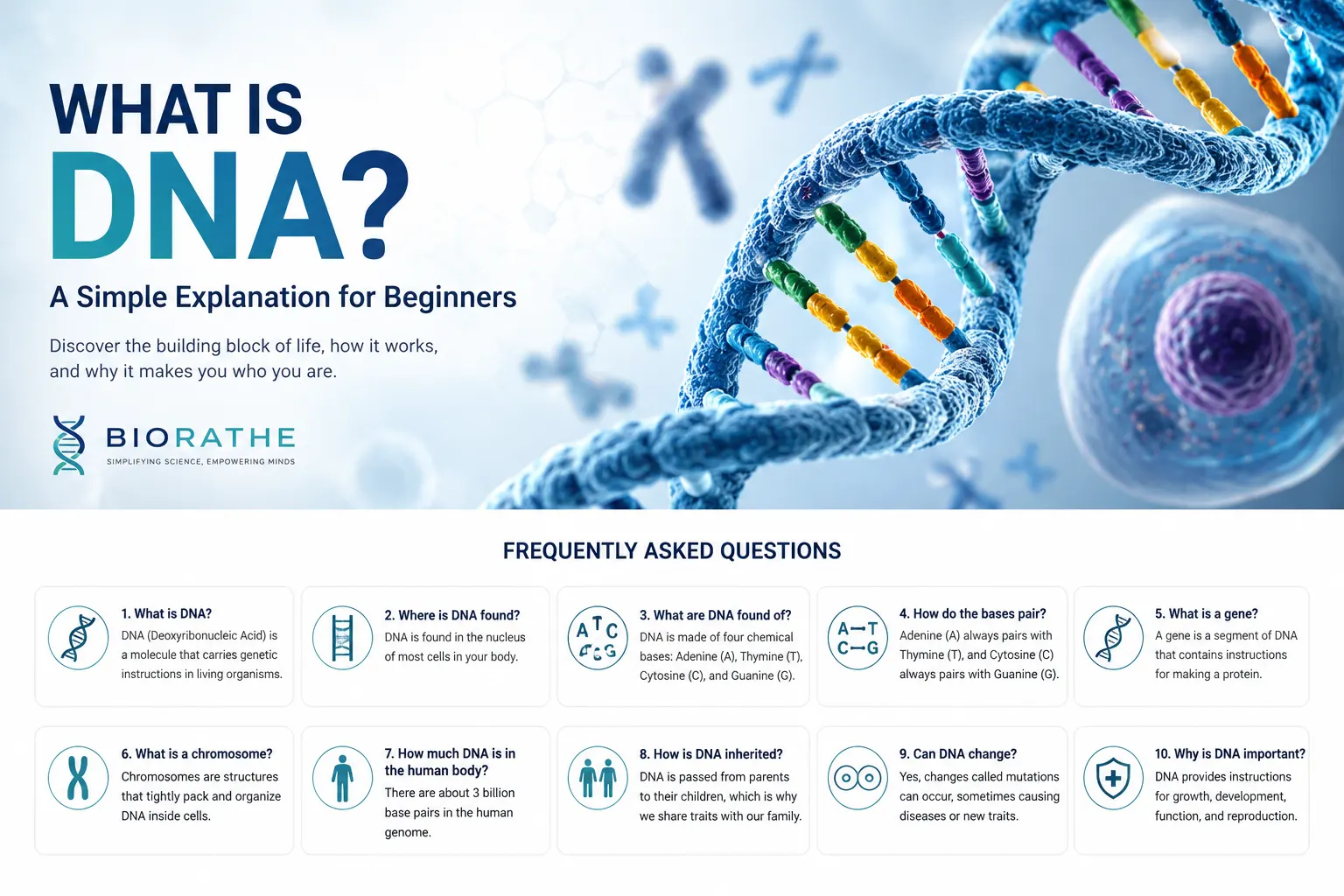
Molecular Biology and Genetics: All living things on Earth (from bacteria to humans) use the exact same genetic code (DNA and RNA). The fact that the human genome shares a 96-98% similarity with chimpanzees, and close to a 50% genetic similarity with bananas, is the molecular signature that all life descended from a single Common Ancestor.
Anatomy and Homology: This refers to different species sharing similar anatomical structures. For example, a human's arm, a cat's leg, a whale's flipper, and a bat's wing share the exact same bone arrangement (homologous structures), despite serving entirely different functions. This proves these creatures evolved from a common mammalian ancestor.
Vestigial Organs: These are structures that have lost their original function during the evolutionary process but still persist in the organism's body. Human wisdom teeth, the tailbone (coccyx), and the appendix, as well as the non-functional hind-leg bones embedded deep within the bodies of whales, are clear examples of vestigial organs.
Biogeography: The geographic distribution of species across the globe perfectly aligns with evolutionary history. The fact that most mammals in Australia are marsupials (kangaroos, koalas) due to the continent remaining isolated for a long time is a direct consequence of continental drift and evolutionary isolation.
Macroevolution and Speciation (Speculation or Fact?)
Evolutionary processes are divided into two categories based on timescale: Microevolution and Macroevolution.
- Microevolution refers to short-term, intra-population changes—such as a bacterial population developing resistance to antibiotics or viruses mutating—and can be observed in a laboratory setting.
- Macroevolution is the process by which new species, genera, and families emerge over millions of years. While some circles accept microevolution but reject macroevolution, biologically speaking, macroevolution is simply the sum of accumulated microevolutionary changes spread over vast stretches of time.
The process of a new species emerging is called Speciation. The most common model of speciation is Allopatric (Geographic) Speciation. A population split in two by a geographic barrier, such as a mountain range, river, or sea, experiences a halt in gene flow between the groups. Each group accumulates different mutations based on its environment and faces distinct natural selection pressures. Millions of years later, when these two groups meet again, the genetic divergence between them has widened so much that they can no longer interbreed and produce fertile offspring. This precise moment marks the birth of a new species.
Conclusion
The Theory of Evolution is the key to understanding nature in a rational, evidence-based manner, free from dogmas. Modern medicine, agriculture, biotechnology, and ecology cannot function without the principles provided by evolutionary biology. Every vital biological process—from predicting antibiotic resistance in bacteria to modeling the mutations cancer cells develop against chemotherapy—is explained by the laws of evolution.
As the famous geneticist Theodosius Dobzhansky beautifully put it: "Nothing in biology makes sense except in the light of evolution."
References
- Coyne, J. A. (2009). Why evolution is true. Oxford University Press.
- Darwin, C. (1859). On the origin of species by means of natural selection, or the preservation of favoured races in the struggle for life. John Murray.
- Dawkins, R. (2009). The greatest show on earth: The evidence for evolution. Free Press.
- Futuyma, D. J., & Kirkpatrick, M. (2017). Evolution (4th ed.). Sinauer Associates.
- Mayr, E. (2001). What evolution is. Basic Books.
- Ridley, M. (2004). Evolution (3rd ed.). Blackwell Publishing.

No comments yet. You can leave the first one.