
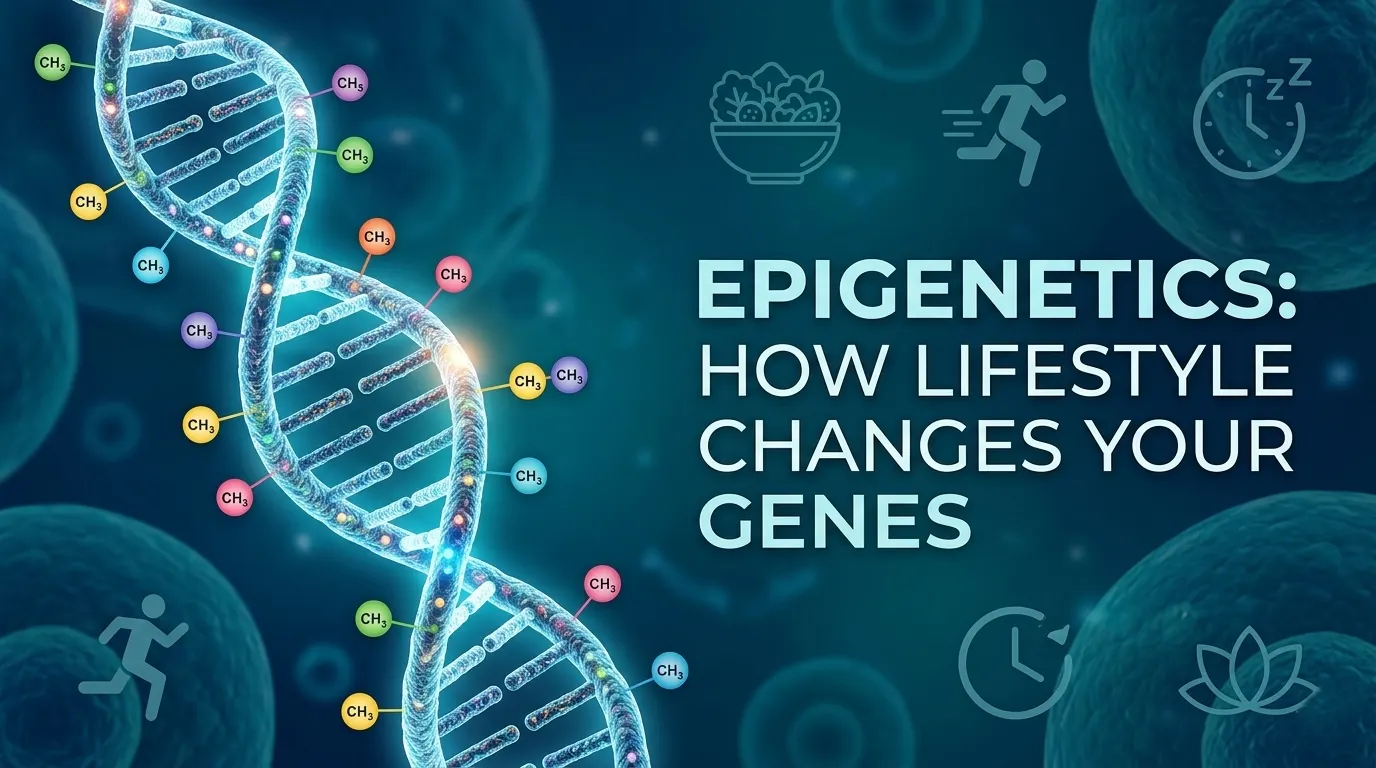
For years, we were told that our genes were an unalterable destiny. Our eye color, our height, and even our risk of developing certain diseases... We believed that everything was permanently sealed in that massive DNA strand inherited from our parents at the moment of our birth. The phrase "It's just my genetics, what can I do?" became a shield for most of us.
However, modern biology has uncovered a monumental discovery that completely shatters these rigid rules: Epigenetics.
Epigenetics reveals a profound truth: Yes, you are given a life script (your DNA sequence) at birth. However, your lifestyle decides how dynamically those scenes will be played, which lines will be censored, or which characters will take the spotlight. In other words, you might not be the absolute ruler of your genes, but you are certainly their conductor.
So, how exactly does this system work? Let’s dive deep into our cells and discover the hidden marks our daily choices leave on our genes.
What is Epigenetics? (In Simple Terms)
If you have an eye for linguistics, you might know that the prefix "Epi-" means "above" or "on top of" in Greek. Therefore, epigenetics literally translates to "above genetics." In technical terms, it is the branch of science that studies how gene activity levels (whether a gene is turned on or off) change without altering the actual DNA sequence itself (the order of the A, T, G, C letters).To understand this better, let’s use a classic analogy:
Think of your DNA as a grand piano. Every single key on that piano represents a gene. The number of keys (your genetic inheritance) is fixed and cannot be changed. However, which keys are pressed and when, how loudly a note resonates, or which keys remain completely silent depends entirely on the pianist. That pianist is your lifestyle.
Our cells manage this mechanism primarily through two main methods:
- DNA Methylation: These are tiny chemical "silencer" tags (methyl groups) attached to the genes. When a gene is methylated, the cell can no longer read it. Essentially, the gene is "turned off."
- Histone Modification: To fit inside a microscopic cell, DNA is tightly wrapped around protein spools called "histones." If these spools are wound too tightly, the genes cannot be read and are turned off. If they are loosened, the genes can be easily read and are "turned on."
How Our Lifestyle Controls Our Genes
Our cells are constantly listening to signals from the outside world. A meal we eat, a wave of chronic stress we experience, or even a night of quality sleep sends a direct command to the cell nucleus: "Turn this gene on, turn that gene off!" Here are the 4 main areas where our lifestyle rewrites our epigenetic codes:- Diet and the "Information" We Consume
The most dramatic example of this is found in honeybees. The genetic codes (DNA) of a queen bee and a worker bee are exactly identical. However, while worker bee larvae are fed royal jelly for only a few days, the queen bee candidate is fed royal jelly continuously. The compounds inside royal jelly trigger epigenetic modifications that activate specific genes in the queen bee's DNA. The result? A queen bee that is multiple times larger than worker bees, highly fertile, and lives for years! In our world, foods like broccoli, cruciferous vegetables, green tea, and folic acid contain powerful methyl donors that keep our cancer-preventing genes "turned on."
- Stress and Emotional Inheritance
Even more striking is the transgenerational transmission of this condition. In a famous study conducted on mice, male mice were exposed to the scent of cherry blossoms while simultaneously receiving a mild electric shock, conditioning them to fear the scent. The miraculous and chilling part of the study showed that the children and even the grandchildren of these mice exhibited panic and fear responses when exposed to the scent for the first time—despite never experiencing the shock or seeing a cherry blossom in their lives. Epigenetic tags can inherit trauma to the next generation via sperm and egg cells.
- Physical Activity and Exercise
- Sleep and Circadian Rhythm
The Best News: Epigenetics is Reversible!
Genetic mutations are permanent. Once a letter changes in the DNA sequence (a mutation), it is nearly impossible to reverse. However, epigenetic modifications are flexible and completely reversible.If you have struggled with poor nutrition, high stress, or a sedentary lifestyle in the past, you might have attached some "bad tags" to your genes. But starting today, the healthy steps you take—such as adopting a Mediterranean diet, practicing meditation, walking regularly, and getting quality sleep—can strip those bad tags away and reawaken your protective genes.
Conclusion: The Pen is in Your Hand
The epigenetic revolution has eliminated the victim mentality in biology. We can no longer step aside and say, "My mother has high blood pressure, so I will definitely have it too." The genes you inherit from your family only dictate a tendency; whether those genes manifest as a disease depends heavily on your daily choices.Your body is a living library that reads the story of your life at a genetic level. Your genetic book may already be written, but the lines you highlight, emphasize, or cross out are still up to the pen in your hand. Take care of yourself, because your cells are listening intently to your every move.
References
- Carey, N. (2012). The epigenetics revolution: How modern biology is rewriting our understanding of genetics, disease, and inheritance. Columbia University Press.
- Dias, B. G., & Ressler, K. J. (2014). Parental olfactory experience influences behavior and neural structure in subsequent generations. Nature Neuroscience, 17(1), 89-96. https://doi.org/10.1038/nn.3594
- Nitert, M. D., Dayeh, T., Volkov, P., Elgzyri, T., Hall, E., Nilsson, E., ... & Ling, C. (2012). Impact of an exercise intervention on DNA methylation in skeletal muscle from first-degree relatives of patients with type 2 diabetes. Diabetes, 61(12), 3132-3142. https://doi.org/10.2337/db11-1653
- Waterland, R. A., & Jirtle, R. L. (2003). Transgenerational epigenetic inheritance of longevity in mammals. Molecular and Cellular Biology, 23(15), 5293-5300. https://doi.org/10.1128/MCB.23.15.5293-5300.2003
No comments yet. You can leave the first one.